
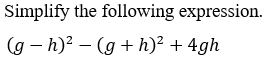
Simplify the following expression. (g − h)² − (g + h)² + 4gh
- (a)−4gh
- (b)4
- (c)0
- (d)4gh
Answer
Why
Correct — C. The stem is an identity, so expand both squares and let them fight.
(g − h)² = g² − 2gh + h²
(g + h)² = g² + 2gh + h²
Subtract: (g² − 2gh + h²) − (g² + 2gh + h²) = −4gh
Now add the trailing term: −4gh + 4gh = 0 → option (c).
Why the others are wrong
- (a)−4gh — −4gh is the value of (g − h)² − (g + h)² on its own. The expression still carries + 4gh, and adding it wipes that term out.
- (b)4 — 4 would need the letters to cancel while the coefficient survived. −4gh and +4gh are equal and opposite whole terms, so they vanish together, the 4 with them.
- (d)4gh — 4gh is what you get by assuming the two squares cancel each other. They do not — their difference is −4gh, and that is what the +4gh cancels.
Concept
Two standard expansions settle this in a line each.
(a + b)² = a² + 2ab + b² and (a − b)² = a² − 2ab + b², so the two differ only in the sign of the middle term. Subtract one from the other and everything except that middle term disappears:
(a − b)² − (a + b)² = −4ab, while (a + b)² − (a − b)² = +4ab.
The order of the subtraction is the whole question. Written the way the paper writes it the result is negative, and the trailing + 4gh is placed exactly to cancel it.
The expression is printed as an image above the options and reads (g − h)² − (g + h)² + 4gh.
Key facts
- (a + b)² − (a − b)² = 4ab, and reversing the order of subtraction reverses the sign.
- (a + b)² + (a − b)² = 2(a² + b²), the companion identity with no cross term.
- Substituting g = 2 and h = 1 gives 1 − 9 + 8 = 0, which confirms the value without any algebra.
- An expression that reduces to 0 is 0 for every g and h, so no substitution can rescue a non-zero option.
Study next
Common traps
- Expanding (g − h)² − (g + h)² as +4gh by subtracting in the wrong order
- Cancelling gh out of the two terms and keeping a bare 4
- Stopping at −4gh and forgetting the + 4gh that follows it
This is a one-line identity item: the whole difficulty is a sign and the order of the subtraction.
The four options are placed so that a single slip lands on one of them — −4gh for stopping before the last term, 4gh for subtracting the squares the other way round, and 4 for cancelling the letters out of the two terms.
Related PYQs
No directly related past PYQ was found.