
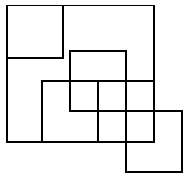
How many squares are there in the figure shown below?
- (a)9
- (b)11
- (c)10
- (d)13
Answer
Why
Correct — B. Count by size class and check all four sides of every candidate.
Rule: count each size separately, then add — smallest cells, then squares two cells to a side, then the outline.
Smallest cells: 5. Three sit side by side in the band across the lower middle, and two more sit directly below the right-hand pair of those three.
Squares two cells to a side: 5. One fills the top-left corner of the outline, one sits in the middle overlapping the others, two rest side by side on the bottom edge, and one hangs outside the bottom-right corner.
The outline itself: 1.
5 + 5 + 1 = 11 → option (b)
Why the others are wrong
- (a)9 — 9 is two short of the total. The two squares that rest side by side on the bottom edge are each crossed by internal lines, so neither reads as a single square unless you go looking for it.
- (c)10 — 10 is one short. Check the outline itself — it is a square and belongs in the count — then recount the smallest cells, of which there are five, not four.
- (d)13 — 13 is two over. It counts regions that look square but never close — the cell just left of centre in the lower row is one, its left side stopping at the middle line and never reaching the bottom edge.
Concept
Square-counting figures are made by overlapping equal squares, and each crossing creates smaller squares that nobody actually drew. Counting only what looks like a square misses those.
Work by size class. Fix the smallest side length in the figure, count every square of that size, then double the side and count again, and finish with the outline.
The discipline that decides the mark is tracing all four sides of a candidate to their corners. A region can look square and still be open, because the line that would close it stops short.
Three regions in the lower band are exactly that trap. The left-hand pair is a tall rectangle with no dividing line through it, and the cell just left of centre in the lower row has no left side — that edge stops at the horizontal line above it.
Key facts
- The count is 5 smallest cells, 5 squares two cells to a side, and 1 outline square.
- A region is a square only when all four of its sides are drawn to their corners.
- Overlapping equal squares create smaller squares that were never drawn as squares.
Study next
Common traps
- Counting a region that is open on one side because its line stops at an intersection.
- Missing the outline, which is itself the largest square present.
- Forgetting the squares that are two cells across and two cells down.
A size-by-size sweep beats recognising shapes at a glance, and these figures are small enough for it. The same task is set at 12 Sep 2024, 12:30, Reasoning Q.10 and at 17 Sep 2024, 12:30, Reasoning Q.1.
Related PYQs
No directly related past PYQ was found.