
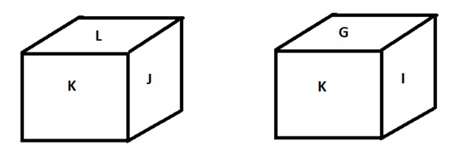
Six letters G, H, I, J, K and L are written on different faces of a dice. Two positions of this dice are shown in the figure below. Find the letter on the face opposite to G.
- (a)J
- (b)K
- (c)I
- (d)L
Answer
Why
Correct — D. The two drawings show:
View 1, with L on top, K on the front face and J on the right.
View 2, with G on top, K on the front face and I on the right.
K keeps the same position in both, so the die has been turned about the K face. That makes L, J, G and I all neighbours of K, and K opposite H, the letter never drawn.
Rule: a turn about K carries the four side faces round a ring, so fix the size of the turn.
A quarter turn one way would bring View 1's top, L, round to the right, but View 2's right is I. A quarter turn the other way would bring View 1's right, J, up to the top, but View 2's top is G.
Both quarter turns fail, so the turn is a half turn, which sends the top face to the bottom. View 2's top, G, was therefore View 1's bottom, lying directly opposite L. That is option (d).
Why the others are wrong
- (a)J — J is opposite I, not G. Under the same half turn View 1's right face J moves to the left, and the face arriving on the right in View 2 is I, its partner.
- (b)K — K is the front face in both drawings, with G on top in View 2, so K and G meet along an edge. K is opposite H, the letter never shown.
- (c)I — I and G appear together in View 2, one on the right and one on top. Faces visible in a single view are adjacent, so I cannot be opposite G.
Concept
When one face keeps its position across two views, the die has been rotated about that face and the other four move round it in a ring. Adjacency alone will not finish this item, because a ring of four admits two different pairings.
K is common, so L, J, G and I ring it and H is opposite K. That knocks out options (b) and (c) and leaves J and L.
To choose between them you need the size of the turn. Ruling out both quarter turns forces a half turn, and a half turn pairs top with bottom and right with left.
This is the harder of the two dice types, because the elimination that settles most such items only narrows the answer here to two letters.
Key facts
- K occupies the front face in both views, so the die was turned about K.
- L, J, G and I are all adjacent to K, which leaves H opposite K.
- A half turn about the front face sends the top face to the bottom and the right face to the left.
- The turn here must be a half turn, because neither quarter turn reproduces View 2.
Study next
Common traps
- Stopping at adjacency, which narrows the answer to J or L but cannot choose
- Assuming a quarter turn without testing whether it reproduces the second view
- Picking K because it is drawn next to G, when being drawn next to G rules K out
SSC gives two views and one shared face. The item immediately before this one, Reasoning Q.10 of this shift, is the easier kind, where the four letters seen alongside the shared face settle the answer with no rotation argument at all.
Related PYQs
No directly related past PYQ was found.