
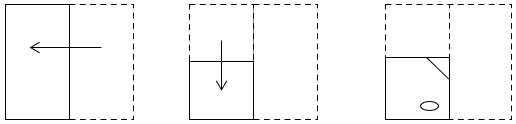
A paper is folded and cut as shown below. How will it appear when unfolded?
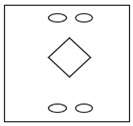
- (a)
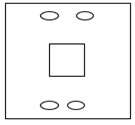
- (b)
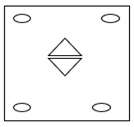
- (c)
- (d)
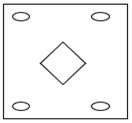
Answer
Why
Correct — A. Rule: unfold in reverse, mirroring each cut across the crease it meets.
The right half folds onto the left, then the top folds onto the bottom, leaving the bottom-left quarter. Two cuts are made in it: a diagonal slicing off its top-right corner, and a small oval near its bottom edge, roughly two-thirds of the way across.
That top-right corner of the quarter is the centre of the sheet. Four mirrored copies of one corner cut meet there and open into a single diamond-shaped hole in the middle.
The oval opens into four ovals, two near the bottom edge and two near the top, each sitting closer to the vertical centre line than to the side edges. Option (a) shows exactly that.
Why the others are wrong
- (b)Option (b) puts an upright square at the centre. A square hole would need a cut running parallel to the edges, but the cut shown is a diagonal, and four mirrored diagonals meet as a diamond.
- (c)Option (c) draws the centre as two triangles split by a horizontal line and moves the ovals to the four corners. The oval was punched on the crease side of the quarter, so its copies stay near the middle.
- (d)Option (d) gets the central diamond right and then places the ovals at the corners. The oval sits about two-thirds across the quarter, nearer the vertical crease than the outer edge, so its copies flank the centre line.
Concept
A cut taken off the corner of a folded stack opens into a shape centred on the point where the creases meet.
Both creases here run through the middle of the sheet, so the sliced corner of the folded quarter is the sheet's centre. Four reflected triangles surround that point and read as a diamond.
A punch away from any crease behaves differently. It simply reappears once per layer, mirrored across each crease, giving four ovals arranged symmetrically about both centre lines.
The two wrong answers that place ovals at the corners are settled by distance, not by shape. Measure the punch against the crease side of the quarter, not against the middle of the quarter.
Key facts
- Two folds give four layers, so a single punch opens into four holes.
- A corner cut at the point where both creases meet opens into a diamond at the centre of the sheet.
- The oval lies nearer the crease edge of the folded quarter than its outer edge, so the copies lie nearer the centre lines than the corners.
Study next
Common traps
- Reading the diagonal corner cut as a notch and drawing an upright square.
- Placing the holes at the corners when the punch sat near the crease.
- Unfolding in the order the folds were made rather than in reverse.
The plain fold-and-cut wording used here returns at 11 Sep 2024, 12:30, Reasoning Q.23 and at 25 Sep 2024, 12:30, Reasoning Q.10. Reasoning Q.3 of the same 13 Sep 2024, 12:30 paper sets the same skill with punched symbols instead of cuts.
Related PYQs
No directly related past PYQ was found.