
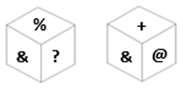
Six symbols %, &, ?, +, $ and @ are written on different faces of a dice. Two positions of this dice are shown in the figure below. Find the symbol on the face opposite to the one having @.
- (a)$
- (b)%
- (c)&
- (d)?
Answer
Why
Correct — D. The symbol & occupies the same position in both views, so the die has only been turned about the axis running through & and the face hidden behind it. The other four symbols keep their cyclic order.
Rule: the four faces around a fixed axis form a ring, and faces two apart in that ring are opposite.
Read each view in the same direction, top face then right face. View 1 gives % then ?. View 2 gives + then @.
The ring must therefore run % → ? → + → @ → %, the single arrangement in which % is followed by ? and + is followed by @.
Two apart in that ring: % faces +, and ? faces @. The face opposite @ is ?, option (d).
Why the others are wrong
- (a)$ — $ appears in neither view. Since the ring around the & axis is made of %, ?, + and @, the face that $ occupies is the one hidden behind &.
- (b)% — % stands one step from @ in the ring, not two. The order % → ? → + → @ puts % opposite +.
- (c)& — & is drawn beside @ in the second view. Two faces you can see in one drawing share an edge, so they are adjacent and can never be opposite.
Concept
Two-view dice items start with a single question: what is common, and did it move? A symbol in the same position in both drawings means the die was turned about that face. A symbol that appears in both drawings but in different positions has moved and cannot be treated as fixed.
With one face pinned, the remaining four form a ring and the turn only slides symbols round it. Reading both views in the same direction — top, then the right-hand face — recovers the ring's order.
Two rules then settle everything: faces seen together are adjacent, and in a ring of four, faces two apart are opposite.
All six symbols are different, so no face repeats and the opposite-face rules apply without qualification. The symbol that appears in neither drawing is not a dead end — it is the fastest route to the face opposite the fixed one.
Key facts
- & holds the same position in both views, which makes it the axis of the turn.
- The ring around that axis runs % → ? → + → @, so % is opposite + and ? is opposite @.
- $ appears in neither view, so it is the face opposite &.
- Any two faces visible in the same drawing are adjacent, never opposite.
Study next
Common traps
- Treating a symbol as fixed because it appears in both views, without checking that it sits in the same position.
- Reading the two views in opposite directions, which reverses the ring.
- Ignoring the symbol that appears in neither view, which is what locates the face opposite the fixed one.
Spatial reasoning in this Reasoning block also covers the paper-folding items at Reasoning Q.3 and Q.9, which reward the same discipline of holding one reference fixed while the view changes.
Related PYQs
No directly related past PYQ was found.