
Simplify (25a² − 10ab − 48b²) ⁄ (5a + 6b) × (5a + 8b)

- (a)

- (b)
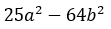
- (c)

- (d)
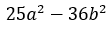
Answer
Why
Correct — B. The numerator factorises so that the printed denominator cancels outright; nothing needs multiplying out.
Split the middle term of 25a² − 10ab − 48b².
You need two numbers summing to −10 whose product is 25 × (−48) = −1200: they are +30 and −40.
25a² + 30ab − 40ab − 48b²
= 5a(5a + 6b) − 8b(5a + 6b)
= (5a + 6b)(5a − 8b)
The (5a + 6b) cancels against the denominator, leaving the printed multiplier:
(5a − 8b) × (5a + 8b)
= 25a² − 64b² → option (b)
Why the others are wrong
- (a)Option (a) shows (5a + 8b)², which would need the numerator to factor as (5a + 6b)(5a + 8b). Expand that and the middle term is +70ab with +48b² at the end — neither matches the printed −10ab − 48b².
- (c)Option (c) is (5a − 8b)². The bracket (5a − 8b) is genuinely the surviving factor, but you multiply it by the (5a + 8b) printed in the question, not by itself.
- (d)Option (d), 25a² − 36b², is (5a − 6b)(5a + 6b). It keeps 6b as the surviving term, but 6b belongs to the factor that cancels; what survives is the 8b bracket.
Concept
A quadratic in two variables factorises exactly like one in a single variable. Read 25a² − 10ab − 48b² as 25x² − 10x − 48 with x standing in for a⁄b, split the middle term, then put b back.
The whole design of the question is that the denominator, (5a + 6b), is one of the two factors. Spot that and three lines of cancelling replace a page of expansion.
The second bracket, (5a + 8b), is then paired with (5a − 8b), so the answer is forced into the difference-of-squares form x² − y².
Stem and all four options are printed as pictures, so the shape of the options is visible before any working: two are perfect squares and two are differences of squares. Deciding which family the answer belongs to settles most of the item.
Key facts
- 25a² − 10ab − 48b² factorises as (5a + 6b)(5a − 8b).
- (5a − 8b)(5a + 8b) = 25a² − 64b², by x² − y² = (x − y)(x + y).
- To split a middle term, find two numbers whose sum is the middle coefficient and whose product is the first coefficient times the last — here −10 and −1200.
- (5a + 6b)(5a + 8b) expands to 25a² + 70ab + 48b², which is why option (a) cannot be the numerator.
Study next
Common traps
- Multiplying the numerator by (5a + 8b) first, which buries the cancellation.
- Cancelling (5a + 6b) on sight without checking it really divides the numerator.
- Getting the factors right and then writing the final product as a square.
The giveaway is the denominator: when a quadratic sits over a linear bracket, that bracket is almost always one of its factors, and the question is testing whether you factorise instead of expand.
The options are built so a sign slip inside the factorisation lands on a real option rather than on nothing.
Related PYQs
No directly related past PYQ was found.