
A circle's centre is connected to its 50 cm long chord by a perpendicular that is 21 cm long. Find the circle's radius.
- (a)
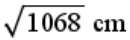
- (b)
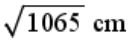
- (c)
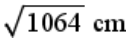
- (d)
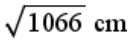
Answer
Why
Correct — D. A perpendicular dropped from the centre onto a chord bisects that chord, so the 21 cm segment meets the 50 cm chord at its midpoint.
Half-chord = 50 ⁄ 2 = 25 cm
Perpendicular from centre = 21 cm
Radius, half-chord and perpendicular form a right triangle, with the radius as hypotenuse:
r² = 25² + 21²
= 625 + 441 = 1066
r = √1066 cm → option (d)
Why the others are wrong
- (a)√1068 overshoots by 2. The only sum on offer is 25² + 21² = 625 + 441 = 1066, so this is an addition slip, not a method error — recheck the two squares before the root.
- (b)√1065 is one short of the true total. 25² = 625 exactly, so a 624 anywhere in the working is the slip; 625 + 441 comes to 1066.
- (c)√1064 is 1066 − 2, the value you get by taking 21² as 439 rather than 441. All four options sit within 4 of each other, so the addition is the entire question.
Concept
One relation covers most chord questions. Drop a perpendicular of length d from the centre to a chord of length c, and it splits the chord into two halves of c⁄2.
That perpendicular, the half-chord and the radius form a right triangle whose hypotenuse is the radius, so r² = d² + (c⁄2)².
The relation runs in either direction: given r and d you get the chord, c = 2√(r² − d²); given c and d you get the radius, as here.
The paper words it as a centre "connected to its chord by a perpendicular", which is the same picture drawn in prose. The four options differ only in the number under the root sign, so no shortcut of estimation will separate them — the arithmetic has to be exact.
Key facts
- A perpendicular from the centre of a circle to a chord bisects that chord.
- For a chord of length c at perpendicular distance d from the centre, r² = d² + (c⁄2)².
- Here 25² = 625 and 21² = 441, so r = √1066 cm, roughly 32.65 cm.
- Run backwards, the same relation gives the chord: c = 2√(r² − d²).
Study next
Common traps
- Using the full 50 cm chord as a leg, which gives √2941 instead of √1066.
- Subtracting the squares — the radius is the hypotenuse here, so the squares add.
- Rushing 625 + 441 when three options sit within 2 of the right total.
SSC asks this relation in both directions and in both roles. This paper runs the tangent version at Quant Q.7 — radius 8 cm, external point 17 cm from the centre.
The chord direction is asked on 19 Sep 2024, 12:30, Quant Q.16 (radius 10 cm, perpendicular 6 cm, find the chord), and the radius direction on 18 Sep 2024, 09:00, Quant Q.25 (chord 32 cm at a distance of 12 cm).
Related PYQs
No directly related past PYQ was found.