
Simplify
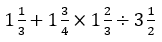
- (a)

- (b)

- (c)

- (d)

Answer
Why
Correct — D. BODMAS: the × and the ÷ are settled before the +, and left to right between themselves.
Convert every mixed number to an improper fraction:
1 1/3 = 4/3, 1 3/4 = 7/4, 1 2/3 = 5/3, 3 1/2 = 7/2
Multiply first: 7/4 × 5/3 = 35/12
Then divide — invert the divisor and multiply: 35/12 × 2/7 = 70/84 = 5/6
Add last: 4/3 + 5/6 = 8/6 + 5/6 = 13/6
13/6 is 2 whole with 1/6 left over = 2 1/6 → option (d)
Why the others are wrong
- (a)2 1/5 is 11/5, and a fifth cannot appear. The four denominators are 3, 4, 3 and 2, and the single 5 in the question is the numerator of 5/3, multiplied in rather than divided by.
- (b)2 1/3 is 7/3 = 14/6, exactly 1/6 above the true 13/6. It is what 1 1/3 + 1 would give, so you land here by taking the multiply-divide group as 1 instead of 5/6.
- (c)3 1/4 is 13/4 ≈ 3.25, outside the range this expression can reach. The multiply-divide group equals 5/6, which is less than 1, so the total has to sit between 1 1/3 and 2 1/3.
Concept
Two rules decide this and nothing else does.
First, BODMAS: multiplication and division outrank addition, so 1 3/4 × 1 2/3 ÷ 3 1/2 is evaluated as a single group before 1 1/3 is added to it.
Second, × and ÷ share a rank and run left to right. Here that ordering happens not to matter, because a × b ÷ c and a × (b ÷ c) agree. It starts mattering the moment a second division joins the chain, so do not learn the shortcut as a rule.
The stem and all four options are printed as images on the response sheet, so the mixed numbers have to be read off the picture rather than from text.
Key facts
- A mixed number a b/c converts to (a × c + b)/c, so 3 1/2 becomes 7/2.
- Dividing by a fraction is multiplying by its reciprocal, so ÷ 7/2 becomes × 2/7.
- 13/6 written as a mixed number is 2 1/6, because 6 goes into 13 twice with 1 remaining.
Study next
Common traps
- Adding 1 1/3 and 1 3/4 first because they come first in the line
- Multiplying by 7/2 instead of 2/7 when the division is carried out
- Reading a mixed number as a product, so 1 2/3 becomes 2/3
The stem is printed as a bare 'Simplify' with the whole expression carried in an image, and the same bare stem appears at 23 Sep 2024, 09:00, Quant Q.7 and at 26 Sep 2024, 16:00, Quant Q.16.
Related PYQs
No directly related past PYQ was found.