
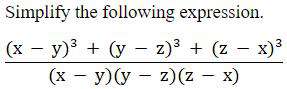
Simplify the following expression. [(x − y)³ + (y − z)³ + (z − x)³] ⁄ [(x − y)(y − z)(z − x)]
- (a)3
- (b)2
- (c)1
- (d)0
Answer
Why
Correct — A. Name the three brackets, then check what they add up to.
Let a = x − y, b = y − z, c = z − x
a + b + c = x − y + y − z + z − x = 0
When a + b + c = 0 the identity gives a³ + b³ + c³ = 3abc.
Numerator = 3(x − y)(y − z)(z − x)
Denominator = (x − y)(y − z)(z − x)
The product cancels, leaving 3 → option (a).
Why the others are wrong
- (b)2 — 2 would need a³ + b³ + c³ = 2abc, which is not the identity. The multiplier it supplies is 3, and it does not depend on x, y or z.
- (c)1 — 1 treats numerator and denominator as the same quantity. They differ by exactly the factor 3 — the cubes sum to three times the product, not to the product itself.
- (d)0 — 0 confuses a + b + c = 0 with a³ + b³ + c³ = 0. The cubes do not vanish; they collapse to 3abc, which is non-zero whenever x, y and z are distinct.
Concept
The identity behind this is a³ + b³ + c³ − 3abc = (a + b + c)(a² + b² + c² − ab − bc − ca).
The right-hand side dies the moment a + b + c = 0, which leaves a³ + b³ + c³ = 3abc.
Differences of the form (x − y), (y − z), (z − x) are the usual disguise for that condition: whatever x, y and z are, those three always sum to zero.
So the expression is 3 for every admissible x, y and z — it is a constant, not a value that happens to come out of one substitution.
The expression is supplied as an image. It reads: [(x − y)³ + (y − z)³ + (z − x)³] ⁄ [(x − y)(y − z)(z − x)].
A numeric check settles it in seconds. Put x = 3, y = 2, z = 1: the top is 1 + 1 − 8 = −6, the bottom is 1 × 1 × (−2) = −2, and the quotient is 3.
Key facts
- a³ + b³ + c³ − 3abc factorises as (a + b + c)(a² + b² + c² − ab − bc − ca).
- If a + b + c = 0 then a³ + b³ + c³ = 3abc.
- (x − y) + (y − z) + (z − x) = 0 for all x, y and z, so the condition is automatic here.
- The given expression therefore equals 3 and is independent of x, y and z.
Study next
Common traps
- Reading a + b + c = 0 as forcing the sum of the cubes to be zero
- Expanding the three cubes term by term and losing a sign in (z − x)³
The same identity is set with numbers rather than letters at 10 Sep 2024, 09:00, Quant Q.22, which gives the sum of three numbers as 18 and the sum of their squares as 36, then asks for the difference between the sum of their cubes and three times of their product.
Related PYQs
No directly related past PYQ was found.