
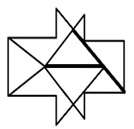
How many triangles are there in the given figure?
- (a)7
- (b)8
- (c)6
- (d)9
Answer
Why
Correct — A. The figure is two rectangles, one left and one right, each open on the side facing the other, with four spikes, one long diagonal and a thick horizontal bar across the middle.
Two landmarks carry the count. The bar's left point is where four slants meet. Its right point is where the long diagonal crosses the slant that runs down to the lower-left spike.
Left rectangle: the arrowhead, made by joining the bar's left point to the rectangle's two left corners. Running total 1.
Across the bar: the tall triangle standing on it and the one hanging below it, each with its apex at a crossing of two slants. Running total 3.
Right rectangle: the long diagonal enters at its top-left corner and leaves at its bottom-right corner, cutting off the upper half; a second triangle stands on its lower edge with its apex at the bar's right point. Running total 5.
The two right-hand spikes: each holds a narrow triangle between its short vertical, the slant leaving its tip and the diagonal cutting across both. Running total 7 — option (a).
Why the others are wrong
- (b)8 — 8 over-counts. The two left-hand spikes look like the right-hand pair, but the slant leaving each of those tips runs on past the spike without meeting its short vertical, so nothing closes there.
- (c)6 — 6 is what you reach by taking the five large triangles and one of the spike triangles. The second spike triangle is the same thin shape at the opposite corner and is the easiest thing here to skip.
- (d)9 — 9 counts shapes rather than triangles. A shape qualifies only if three drawn segments meet pairwise at three points, and several tempting regions here are closed by four segments or by a line that stops short.
Concept
Counting goes wrong when you scan for triangle-shaped white space. Count by line, not by look.
A triangle needs three drawn segments that genuinely meet in pairs, at three different points. A slant that passes close to a vertical without reaching it closes nothing.
The reliable method is to work outward from the busiest junctions. The horizontal bar has one at each end, and four of the seven triangles use one of those two points as a vertex.
The other three are quieter: the long diagonal splits the right rectangle corner to corner, and each right-hand spike holds a thin triangle where a diagonal cuts across it.
The figure is drawn freehand and the lines are thick, so two of the seven are slivers inside the right-hand spikes. Trust the geometry over the ink — each is bounded by the spike's short vertical, the slant leaving its tip and the diagonal crossing both.
Key facts
- A triangle in a counting item needs three drawn segments meeting pairwise at three distinct points.
- The horizontal bar's two end junctions are vertices of four of the seven triangles here.
- The long diagonal runs from the upper-left spike's tip to the right rectangle's bottom-right corner, splitting that rectangle corner to corner.
Study next
Common traps
- Counting the two left-hand spikes as triangles when nothing crosses them
- Missing the thin triangles inside the right-hand spikes
- Counting a four-sided region because it looks triangular at a glance
SSC asks the count straight — how many triangles, how many squares — and keeps the figure small enough to enumerate by hand. Picture reasoning also appears in this shift at Reasoning Q.22 (mirror image), Q.23 (paper folding) and Q.25 (embedded figure).
Related PYQs
No directly related past PYQ was found.