
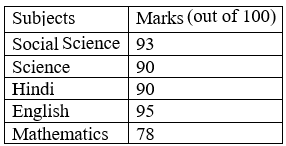
The given table shows the marks obtained by a student in class 9. What is the percentage of marks obtained by the student?
- (a)88%
- (b)90%
- (c)88.8%
- (d)89.2%
Answer
Why
Correct — D. Add the five rows of the table, then divide by the total maximum.
Total scored = 93 + 90 + 90 + 95 + 78
= 446
Maximum = 5 subjects × 100 marks = 500
Percentage = (446 ⁄ 500) × 100
= 89.2% → option (d).
Why the others are wrong
- (a)88% — 88% is 440 out of 500 — six marks below the total the table actually gives. Re-add the marks column before settling on a round-looking figure.
- (b)90% — 90% needs 450 marks. It is also the number printed against Science and against Hindi, so it reads like a row value picked up instead of the aggregate.
- (c)88.8% — 88.8% is 444 out of 500, two marks short of 446. A single mis-copied row is enough to produce it, which is why the sum is worth doing twice.
Concept
A percentage of marks is scored total ÷ maximum total, not the average of the individual subject percentages.
The two routes agree here only because all five subjects carry the same maximum of 100. Keep the sum-then-divide habit anyway.
The moment one subject is out of 50 or 175 while the rest are out of 100, averaging the subject percentages stops being valid and the weighted sum is the only correct route.
The table is supplied as an image. Its five rows read Social Science 93, Science 90, Hindi 90, English 95 and Mathematics 78, each out of a maximum of 100.
Key facts
- The marks in the table are 93, 90, 90, 95 and 78, each out of 100.
- Their sum is 446 against a total maximum of 500, so the percentage is 89.2.
- Averaging subject percentages equals the overall percentage only when every subject carries the same maximum.
Study next
Common traps
- Dividing by 100 instead of by the total maximum of 500
- Reading a single row (90) as the answer because two subjects happen to share it
A marks table with a percentage question is also set at 19 Sep 2024, 09:00, Quant Q.23, where four students are scored across four subjects out of 175 each and the aggregate percentage for one of them is wanted.
Related PYQs
No directly related past PYQ was found.