
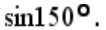
Find the exact value of
- (a)1.5
- (b)0.5
- (c)0.75
- (d)-0.5
Answer
Why
Correct — B. 150° lies in the second quadrant, where sine is positive.
Write 150° as 180° − 30°
sin(180° − θ) = sin θ
So sin 150° = sin 30°
sin 30° = 1⁄2 = 0.5 → option (b)
Why the others are wrong
- (a)1.5 — The sine of any angle lies between −1 and 1, so 1.5 cannot be the sine of anything. The rule 180° − θ changes neither the function nor its sign here.
- (c)0.75 — 0.75 is not the sine of any standard angle. The second-quadrant values come from sin 30° = 0.5, sin 45° ≈ 0.707 and sin 60° ≈ 0.866.
- (d)-0.5 — The magnitude is right and the sign is wrong: sine is positive in the second quadrant. −0.5 is sin 210° or sin 330°, and it is also cos 120°.
Concept
Allied-angle rules reduce any angle to a first-quadrant one. For 180° − θ the function name does not change, and the sign follows the quadrant: in the second quadrant sine and cosec are positive and everything else is negative.
So sin 150° = sin 30° = 1⁄2, while cos 150° = −cos 30° = −√3⁄2 — the same construction, opposite sign, because cosine is negative there.
ASTC — All, Sine, Tangent, Cosine positive in quadrants one to four — is the compact form of that sign rule.
The stem is printed as Find the exact value of, with the expression stored as an image reading sin150°. Exact warns against a calculator-style approximation, though here the exact value happens to be the terminating decimal 0.5.
Key facts
- sin(180° − θ) = sin θ, so sine keeps both its name and its sign in the second quadrant.
- sin 30° = 1⁄2, cos 30° = √3⁄2 and tan 30° = 1⁄√3.
- The sine of any angle lies between −1 and 1 inclusive.
Study next
Common traps
- Writing 150° as 90° + 60° and then mishandling the sign, which produces −0.5.
- Assuming sine goes negative simply because the angle is past 90°.
- Confusing sin 150° with cos 150°, which is −√3⁄2.
Standard-angle values are asked directly, as here, or buried inside an identity. Quant Q.24 of this same paper takes the second route with a cosec and cot expression that has to be simplified before any value is substituted.
Related PYQs
No directly related past PYQ was found.