
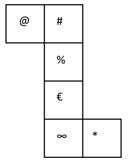
A cube is constructed by folding the given sheet along the lines shown. In the cube so formed, what would be the symbol on the opposite side of ‘#’?
- (a)@
- (b)∞
- (c)€
- (d)%
Answer
Why
Correct — C. Read the net as columns before folding anything.
Rule: in a straight strip of four squares, the 1st folds opposite the 3rd and the 2nd opposite the 4th.
One column of this sheet runs, top to bottom: #, %, €, ∞.
So # is 1st in that strip and € is 3rd — they land on opposite faces. That also pairs % with ∞, and leaves @ (beside #) with the sixth symbol (beside ∞).
The face across from # is therefore €, option (c).
Why the others are wrong
- (a)@ — @ sits side by side with # in the top row of the sheet. Squares sharing an edge in a net fold into faces that touch, never into opposite faces.
- (b)∞ — ∞ is the fourth square of the same vertical strip, so it folds opposite the second square, %, not opposite the first.
- (d)% — % sits directly below # in the strip and shares an edge with it, which makes the two faces adjacent on the finished cube.
Concept
A cube net holds six squares and three opposite pairs. The fastest reliable tool is the strip rule: four squares in an unbroken straight line wrap right round the cube, so the 1st faces the 3rd and the 2nd faces the 4th.
Find the longest straight run first. Anything hanging off that run pairs with whatever hangs off it two steps away.
Squares that touch along an edge are always adjacent on the cube. A shared border is an instant elimination, and it removes two of the three wrong options here.
The sixth square of this sheet, hanging to the right of ∞, carries a symbol too small to read cleanly in the scan. Nothing in the answer depends on it — it is the partner of @, and both sit outside the # / € pair.
Key facts
- In a straight strip of four net squares, square 1 is opposite square 3 and square 2 is opposite square 4.
- Two net squares that share an edge always become adjacent faces, never opposite ones.
- This sheet's vertical strip reads #, %, €, ∞ from top to bottom.
Study next
Common traps
- Treating squares that meet only at a corner as opposite faces.
- Starting the mental fold from the wrong square and losing track of which face is first in the strip.
The companion form — two views of one dice instead of a net — is at 12 Sep 2024, 16:00, Reasoning Q.25, and it is settled by elimination rather than by the strip rule.
Related PYQs
No directly related past PYQ was found.