
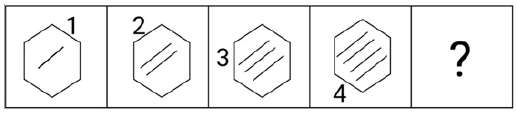
Select the figure from among the given options that can replace the question mark (?) in the following series.
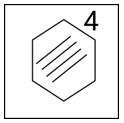
- (a)
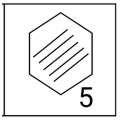
- (b)
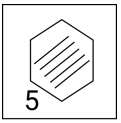
- (c)
- (d)
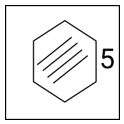
Answer
Why
Correct — B. Two things advance together across the four hexagons, and both have to be matched.
Rule: one more diagonal stroke at each step, and the numeral moves a sixth of a turn anticlockwise around the hexagon.
Strokes: figure 1 carries 1, figure 2 carries 2, figure 3 carries 3, figure 4 carries 4, so the fifth carries 5.
Numeral: the 1 sits at the top right, the 2 at the top left, the 3 at the left, the 4 at the bottom left, so the 5 belongs at the bottom right.
Option (b) is the hexagon with five parallel strokes and its numeral placed below and to the right — the only option that satisfies both.
Why the others are wrong
- (a)Option (a) shows only four strokes and puts its numeral at the top right, where figure 1's label sat. Both the count and the position are a step behind.
- (c)Option (c) has the five strokes but leaves the numeral at the bottom left, which is the position figure 4 already used, so nothing has moved.
- (d)Option (d) has the five strokes and carries the numeral to the right of the hexagon, one step further round than the bottom right the series calls for.
Concept
A figure series can advance more than one attribute at a time, and an option that matches only the obvious one is designed to be chosen. Here the stroke count is the obvious attribute and the numeral's place is the quiet one.
The numeral is part of the drawing, not a panel label. You can tell because it moves: a label would sit in the same corner of every frame. Comparing consecutive frames element by element is what surfaces a second rule like this.
The strokes are parallel and evenly spaced, so their direction never changes and the hexagon never rotates. Only the count and the numeral's position carry information.
Key facts
- The stroke count runs 1, 2, 3, 4 across the four given hexagons.
- The numeral changes place from one hexagon to the next, which is what marks it as part of the figure.
- Each move of the numeral is a sixth of a turn anticlockwise, from top right to top left to left to bottom left.
Study next
Common traps
- Reading the numerals as panel labels and matching the stroke count alone, which three options satisfy.
- Counting the strokes hurriedly and settling for the four-stroke figure.
- Assuming the rotation is clockwise without checking the first two frames against each other.
SSC prints four framed figures and a question mark and asks for the fifth; here two attributes advance together, a count and a position. The same question type runs on 9 Sep 2024, 12:30, Reasoning Q.8 and on 11 Sep 2024, 16:00, Reasoning Q.7.
Related PYQs
No directly related past PYQ was found.