
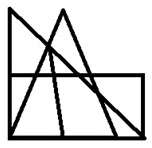
How many triangles are there in the given figure?
- (a)13
- (b)12
- (c)15
- (d)14
Answer
Why
Correct — D. SSC's key marks 14, option (d).
Name the lines before counting anything. There are eight.
Frame: the left vertical, the horizontal mid-line, the bottom edge, and the short right vertical that runs only below the mid-line.
Across it: the long diagonal from the top of the left vertical to the bottom-right corner;
the peak's left leg down to the bottom-left corner;
its right leg down to a point on the bottom edge;
and the near-vertical stroke that drops from the diagonal's crossing with the left leg to the bottom edge.
Rule: three lines make a triangle when each pair of them meets and the three meeting points are distinct.
Now take the triples by the line that closes them.
Closed by the mid-line — 8 of them:
left vertical + diagonal; left vertical + left leg; right vertical + diagonal;
diagonal + left leg; diagonal + right leg; diagonal + stroke;
left leg + right leg; left leg + stroke.
Closed by the bottom edge — 6 of them:
left vertical + diagonal; diagonal + left leg; diagonal + right leg;
diagonal + stroke; left leg + right leg; left leg + stroke.
Three triples enclose nothing, because their lines all run through one point:
left vertical, bottom edge and left leg at the bottom-left corner;
bottom edge, right vertical and diagonal at the bottom-right corner;
and diagonal, left leg and stroke at the crossing the stroke starts from.
Closed by neither: left vertical + diagonal + left leg, and diagonal + left leg + right leg — 2.
8 + 6 + 2 = 16 if the right leg is followed all the way down to the bottom edge.
Read that leg as stopping where the diagonal cuts it and the two shapes needing its lower tail fall away — right leg + bottom edge + diagonal, and right leg + bottom edge + left leg. 16 − 2 = 14, option (d).
Why the others are wrong
- (a)13 — 13 is one below the keyed 14. It is the count you reach by missing the largest shape of all — left vertical, bottom edge and the long diagonal — whose three sides are already doing duty inside smaller triangles.
- (b)12 — 12 is two below the keyed 14. Drop the pair of small triangles the near-vertical stroke cuts out against the mid-line — stroke with the diagonal, and stroke with the left leg — and 14 falls to 12.
- (c)15 — 15 is one above the keyed 14. It is what you get by counting one of the two shapes that stand on the bottom edge and need the right leg's tail below the diagonal, and not the other. The key counts neither.
Concept
Counting triangles is a search over triples of lines, not over shapes that catch the eye. Every triangle is three of the drawn lines meeting pairwise at three different points, so listing the lines first and then working through their combinations is what makes the count repeatable.
Two shortcuts help. Lines that all pass through one point enclose nothing, so any triple that is concurrent can be dropped at once. And a side is never used up: one long line can be a side of several different triangles.
The four options sit one apart at 12, 13, 14 and 15. That spacing is deliberate — a single missed or repeated shape still lands you on an option, so nothing about a wrong answer feels wrong at the time.
Key facts
- A triangle here is three of the drawn lines meeting pairwise at three distinct points.
- Three lines through a common point enclose no area, so such a triple is not a triangle.
- The same drawn line can be a side of several triangles at once.
Study next
Common traps
- Counting the small cells only and missing the large triangles built from them.
- Finding the same shape twice from two different corners.
- Trusting a quick visual sweep on a figure where three lines nearly meet at one point.
A line drawing with numeric options rewards a written method over a visual sweep. The same question type runs on 11 Sep 2024, 09:00, Reasoning Q.3, where the options are 8, 9, 10 and 11, and on 9 Sep 2024, 12:30, Reasoning Q.1, where they are 3, 4, 5 and 6.
Related PYQs
No directly related past PYQ was found.