
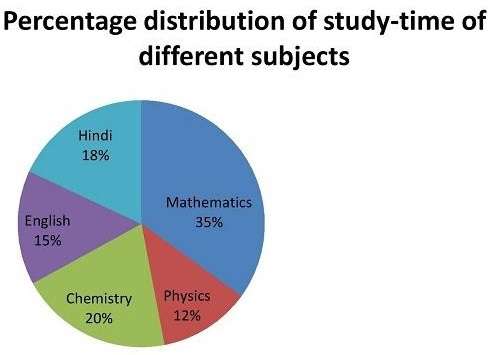
The following pie chart shows the study time of different subjects of a student in a day. Study the pie chart and answer the question. If the student studied English for 3 hours, then he studied Mathematics for:
- (a)5 hours
- (b)1 hour
- (c)2 hours
- (d)7 hours
Answer
Why
Correct — D. The pie chart reads English 15% and Mathematics 35%, so the two study times stand in the ratio 15 : 35.
English 15% = 3 hours
1% = 3 ⁄ 15 = 0.2 hour
Mathematics 35% = 35 × 0.2 = 7 hours → option (d).
Ratio route, same answer: Mathematics ⁄ English = 35 ⁄ 15 = 7 ⁄ 3, so Mathematics = 3 × 7 ⁄ 3 = 7 hours.
Why the others are wrong
- (a)5 hours — 5 hours corresponds to 25% of the day, and no slice in the chart reads 25%. Mathematics is labelled 35%, which converts to 7 hours.
- (b)1 hour — 1 hour is below English's 3 hours, yet Mathematics has the larger slice, 35% against 15%. Any answer under 3 hours contradicts the chart before the arithmetic starts.
- (c)2 hours — 2 hours matches 10%, a figure the chart does not carry, and it again falls below English's 3 hours despite Mathematics owning the bigger share.
Concept
A pie chart fixes shares, not amounts. One known amount unlocks every other slice: divide the known value by its percentage to get the value of one per cent, then multiply.
Here 3 hours ÷ 15 gives 0.2 hour per per cent, so Mathematics at 35% is 7 hours. Working in ratios reaches the same place, since the times are in the same ratio as the percentages.
Percentages in a valid pie chart total 100 and the central angles total 360°, which makes 1% equal to 3.6°.
Taken literally the figures imply 3 ÷ 0.15 = 20 hours of study in a single day. The chart is a percentage exercise rather than a plausible timetable, and the arithmetic is unaffected.
Key facts
- The chart reads Mathematics 35%, Chemistry 20%, Hindi 18%, English 15% and Physics 12%, totalling 100%.
- One known value converts the whole chart: 3 hours ÷ 15 = 0.2 hour per per cent.
- Mathematics at 35% is therefore 35 × 0.2 = 7 hours.
- In a pie chart 1% is a central angle of 3.6°, so the 35% Mathematics slice measures 126°.
Study next
Common traps
- Answering with a value below English's 3 hours although Mathematics has the larger slice.
- Treating the 3 hours as the whole day and taking 35% of it.
- Mixing per cent and degrees when a chart labels one and asks about the other.
The convert-one-slice pie chart runs across shifts. A combined central angle for two slices is asked on 13 Sep 2024, 09:00, Quant Q.20, a percentage of students in one course on 11 Sep 2024, 09:00, Quant Q.14, and a chart labelled in degrees on 18 Sep 2024, 12:30, Quant Q.11.
Related PYQs
No directly related past PYQ was found.