
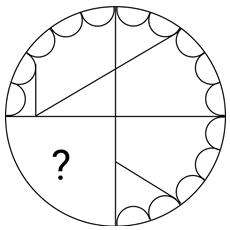
Select the option figure that will replace the question mark (?) in the figure given below and complete the pattern.
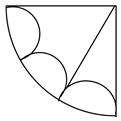
- (a)
- (b)
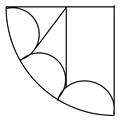
- (c)
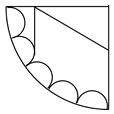
- (d)
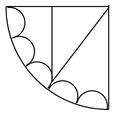
Answer
Why
Correct — C. A horizontal and a vertical diameter cut the circle into four quadrants, and the bottom-left one is missing. Each option is drawn as that quadrant, with the circle's centre at its top-right corner.
Rule: the figure is symmetric about the horizontal diameter, so the missing quadrant is the top-left quadrant flipped downwards.
Test the rule on the half you can see. The top-right quadrant carries a chord running from the vertical diameter, about 0.4 of a radius above the centre, out to the arc — and the bottom-right quadrant carries that same chord the same distance below the centre.
The top-left quadrant carries small scallops along its whole arc, a short line dropped square from the horizontal diameter about 0.7 of a radius out from the centre up to the arc, and a chord from that same foot rising to the vertical diameter.
Flip it downwards and you need scallops along the arc, a perpendicular at the same 0.7 mark going down to the arc, and a chord from that foot down to the vertical radius. That is option (c).
Why the others are wrong
- (a)Its arc carries three oversized scallops where the rest of the circle is ringed with small ones, and its oblique line runs out of the centre corner instead of from a point on the horizontal radius.
- (b)Also three oversized scallops, and its oblique runs down-left from the foot into the arc rather than down-right to the vertical radius, so it mirrors nothing in the top half.
- (d)The scallops are right, but its oblique starts at the centre corner, making it a radius. The chord it has to mirror starts out on the horizontal diameter and meets the vertical one below the centre.
Concept
Pattern completion inside a single divided figure, not a series. Nothing progresses from one quadrant to the next — the four quadrants stand in a symmetry relation.
The way in is to find the symmetry from the three quadrants you can see. Here the right half is a mirror of itself about the horizontal diameter, and once that is established the missing piece is fully determined by the top-left quadrant.
Then compare the options on the two things that actually differ: where each straight line starts, and how the arc is decorated.
The stem figure leaves the missing quadrant's arc completely plain, so the scallops there have to be inferred from the rest of the rim rather than read off the picture.
Key facts
- The scallops are small inward semicircles sitting on the rim, and they ring the three drawn quadrants.
- The top-right chord meets the vertical diameter about 0.4 of a radius above the centre.
- The bottom-right chord meets it the same distance below the centre, which fixes the mirror line as the horizontal diameter.
- The top-left quadrant's perpendicular stands about 0.7 of a radius out from the centre along the horizontal diameter.
Study next
Common traps
- Assuming a 90 degree rotation because the figure is a circle cut into quarters.
- Choosing on the straight lines alone and ignoring how many scallops the arc carries.
- Missing that the option quadrants are drawn with the circle's centre at the top-right corner, not at the centre of the box.
SSC prints the incomplete figure once and the four candidate quadrants beside it, at a size where the scallops are the easiest feature to count. A flip about a straight line is also what the mirror-image item at Reasoning Q.6 of this 12 Sep 2024, 12:30 paper asks for.
Related PYQs
No directly related past PYQ was found.