
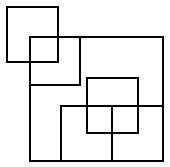
How many squares are there in the given figure?
- (a)10
- (b)9
- (c)7
- (d)8
Answer
Why
Correct — B. Rule: count by size, and accept a box only when all four of its sides are drawn.
Large, 1: the big square that fills the figure.
Medium, 5: the square hanging off the top-left corner, the equal square overlapping it at the big square's corner, the square that hangs across the lower middle, and the two side-by-side squares sitting on the bottom edge.
Small, 3: the patch where the two top-left squares cross, plus the two cells that the long horizontal line and the vertical below it cut out of the lower half of the middle square.
1 + 5 + 3 = 9 — option (b).
Why the others are wrong
- (a)10 — Ten is one too many. The block along the bottom right, closed by the long horizontal and the big square's right edge, is twice as wide as it is tall — a rectangle, not a square.
- (c)7 — Seven keeps the middle square whole and misses the two small cells that the horizontal line and the vertical cut out of its lower half.
- (d)8 — Eight is what you get after missing the overlap patch where the two squares at the top-left cross. That overlap is itself a square and has to be counted.
Concept
Counting figures is a systematic job, not a visual one. Work by size: take every smallest square first, then every square built from the next size up, and finish with the largest.
A shape counts only when all four of its sides are actually drawn. A region closed on three sides by nothing is not a square, and neither is a bounded box that is wider than it is tall.
Overlaps are the easy marks and the easy misses. Where two squares cross squarely, the overlapping patch is itself a square and belongs in the total.
The stem is a picture, so the layout is read off the image: a large square, two equal squares overlapping its top-left corner, one medium square hanging across its lower middle, and a horizontal line with a vertical beneath it that split the bottom strip into two medium squares.
Key facts
- The nine break down as 1 large, 5 medium and 3 small squares.
- The overlap of two crossing squares is itself a square only when the crossing is square on both axes.
- A bounded region wider than it is tall is a rectangle and must be left out of the count.
Study next
Common traps
- Counting the wide block on the bottom right, which is a rectangle two squares across
- Missing the overlap patch between the two squares at the top-left corner
- Missing the two small cells inside the medium square that hangs across the middle
Square-counting figures are asked at 17 Sep 2024, 12:30, Reasoning Q.1, where the key is 20, and at 25 Sep 2024, 09:00, Reasoning Q.3, where it is 17.
Related PYQs
No directly related past PYQ was found.