
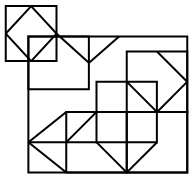
How many triangles are there in the given figure?
- (a)16
- (b)21
- (c)20
- (d)18
Answer
Why
Correct — B. Work block by block, and inside a block count by size: the smallest triangles first, then the larger ones the drawing builds out of them.
Top-left square — 5. Joining the four side-midpoints cuts 4 corner triangles off. The second square's left edge then crosses the diamond just above the bottom edge, slicing 1 more off the bottom-left corner triangle. The diamond itself has four sides, so it does not count.
Below the long horizontal — 3. Two slopes fall to one point on the short vertical: 2 halves and the whole.
Right-hand block — 4. A wedge under the upper edge, 2 from the square its diagonal splits, a wedge onto the right edge.
Lower band — 9. 2 in the cell one diagonal halves, 3 from the wedge pair stacked either side of the horizontal with their apex on the left edge, 1 more filling the bottom-left corner, 3 from the V standing on the bottom edge.
5 + 3 + 4 + 9 = 21 → option (b).
Why the others are wrong
- (a)16 — 16 is five short, and five is what the top-left square holds — its 4 cut corners plus the sliver the second square's left edge shaves off the bottom-left one. Leave that block out and you land here.
- (c)20 — 20 is one below the keyed count. A single missed wedge, of the kind a diagonal makes where it meets an edge, is enough to land here.
- (d)18 — 18 is three short. Three of the 21 are not single shapes but a pair of smaller triangles read as one — below the long horizontal, beside the tall vertical, and at the V on the bottom edge.
Concept
Triangle counting rewards a system rather than sharp eyes, and the reliable system has two halves.
First, partition the drawing into blocks — each square or rectangle that carries its own diagonals — and finish one block before starting the next. Lines shared between blocks are handled at the end.
Second, inside a block, count by size. Take the smallest triangles first, then the larger ones the drawing builds out of them, size class by size class. Writing down the count for each class is what stops you counting the same shape twice.
Shapes with four sides never enter the count, however triangular they look at a glance.
Three of the 21 are not drawn as single shapes. They exist only because two smaller triangles share an edge and their outer sides continue in a straight line.
So finish each block, then go back and look for the pairs before you total.
Key facts
- The top-left square has the midpoints of its four sides joined, which cuts four triangles off its corners.
- The diamond enclosed by those four joins is a quadrilateral and is not counted.
- A triangle built from two or more smaller triangles counts as a triangle in its own right.
- This figure holds 21 triangles, and 3 of them are a pair of smaller triangles read as one — miss that class and you stop at 18.
Study next
Common traps
- Counting only the smallest triangles and stopping.
- Counting the same large triangle twice, once from each of two corners.
- Reading a four-sided shape with a cut corner as a triangle.
Label every intersection point before you start, then count size class by size class. A drawing this dense will lose or repeat a triangle under an unlabelled sweep, and there is no way to check your total afterwards.
Related PYQs
No directly related past PYQ was found.