
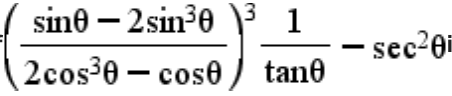
The value of is:
- (a)2
- (b)−1
- (c)1
- (d)0
Answer
Why
Correct — B. Factor the top and the bottom of the bracket — a cos 2θ falls out of both.
sin θ − 2sin³θ = sin θ(1 − 2sin²θ) = sin θ · cos 2θ
2cos³θ − cos θ = cos θ(2cos²θ − 1) = cos θ · cos 2θ
The cos 2θ cancels, leaving sin θ ⁄ cos θ = tan θ
So the bracket cubed is tan³θ, and tan³θ × (1 ⁄ tan θ) = tan²θ.
tan²θ − sec²θ = −(sec²θ − tan²θ) = −1 → option (b).
Why the others are wrong
- (a)2 — 2 is a coefficient printed inside the bracket, not a value the expression can take. sec²θ exceeds tan²θ by exactly 1, so their difference is fixed whatever θ is.
- (c)1 — 1 is sec²θ − tan²θ, the identity taken in the opposite order. This expression subtracts sec²θ from tan²θ, so the sign flips.
- (d)0 — 0 assumes sec²θ = tan²θ, dropping the 1 in sec²θ = 1 + tan²θ. That 1 is the whole answer here.
Concept
Two double-angle forms are hiding in the bracket: 1 − 2sin²θ = cos 2θ and 2cos²θ − 1 = cos 2θ. They are the same quantity, so once both are factored out the bracket collapses to tan θ.
After that the item is a single identity, sec²θ − tan²θ = 1. The cube and the 1 ⁄ tan θ exist only to turn tan θ into tan²θ, so the final subtraction is forced.
The value does not depend on θ at all. That independence is the signal that an identity, not an angle, is being tested.
The expression is printed as an image, so a text-only view of this row shows just the words The value of is.
It is undefined wherever the working divides by zero — at θ = 45°, where cos 2θ = 0, and wherever tan θ or cos θ is zero. Away from those angles the value is the constant −1.
Key facts
- cos 2θ = 1 − 2sin²θ = 2cos²θ − 1.
- sec²θ − tan²θ = 1, so tan²θ − sec²θ = −1 wherever both are defined.
- (sin θ − 2sin³θ) ⁄ (2cos³θ − cos θ) simplifies to tan θ.
Study next
Common traps
- Substituting a convenient angle such as 45°, where this expression is undefined.
- Cancelling sin θ against cos θ rather than cos 2θ against cos 2θ.
- Applying the cube to the numerator of the bracket alone.
SSC builds these so a messy bracket reduces to a single ratio and the answer is a constant. If your value still contains θ, the factoring is unfinished.
Identity manipulation of the same kind is asked at Quant Q.21 of this paper and at Quant Q.1 of 25 Sep 2024, 09:00.
Related PYQs
No directly related past PYQ was found.