
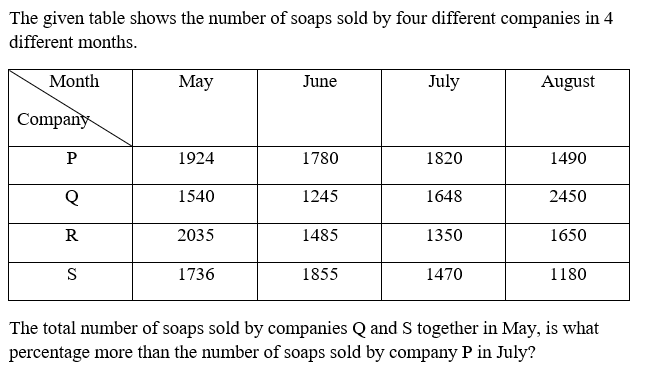
The given table shows the number of soaps sold by four different companies in 4 different months. Company/Month → May | June | July | August P — 1924 | 1780 | 1820 | 1490 Q — 1540 | 1245 | 1648 | 2450 R — 2035 | 1485 | 1350 | 1650 S — 1736 | 1855 | 1470 | 1180 The total number of soaps sold by companies Q and S together in May, is what percentage more than the number of soaps sold by company P in July?
- (a)65%
- (b)90%
- (c)80%
- (d)75%
Answer
Why
Correct — C. Read the two figures off the table, then compare their difference with the July figure.
Q in May = 1540 and S in May = 1736
Q + S = 1540 + 1736 = 3276
P in July = 1820
Excess = 3276 − 1820 = 1456
Percentage more = 1456 ⁄ 1820 × 100 = 80% → option (c).
The divisor is P's July figure, because that is the quantity the May pair is being measured against.
Why the others are wrong
- (a)65% — 65% would need the May pair to reach 3003 (1820 × 1.65). Q and S actually sold 1540 + 1736 = 3276, an excess of 1456 rather than 1183.
- (b)90% — 90% would need 3458 (1820 × 1.9). The May pair stops at 3276, so the excess is 1456 and not 1638.
- (d)75% — 75% would need 3185 (1820 × 1.75). It is the nearest wrong value, but 1456 ⁄ 1820 is exactly 0.8, so no estimate is involved.
Concept
A is what percentage more than B always divides by B, the quantity being compared against.
Here B is P's July output, 1820, and A is the May total for Q and S, 3276. The excess 1456 goes over 1820 — not over 3276, and not over the two added together.
A table item like this is two acts of reading and one of arithmetic. Most of the marks lost are lost in the reading: the wrong month column, or the wrong company row.
The stem is printed as an image in the paper — a table of soaps sold by companies P, Q, R and S across May, June, July and August — so a text-only view of this row shows an empty question.
Key facts
- Percentage more than B = (A − B) ⁄ B × 100.
- Q and S sold 1540 and 1736 soaps in May, a total of 3276.
- P sold 1820 soaps in July, and 1456 ⁄ 1820 = 0.8 exactly.
Study next
Common traps
- Dividing 1456 by 3276 instead of by 1820, which gives about 44 percent.
- Answering 180 percent, which is 3276 as a percentage of 1820 rather than the excess.
- Reading P's May figure 1924 in place of its July figure 1820.
SSC prints the table as a picture with one comparison sentence beneath it, so the marks turn on which row and which column that sentence names.
Table reading is also asked at Quant Q.12 and Q.13 of this paper — a cumulative marks table at Q.12 and refrigerator production at Q.13.
Related PYQs
No directly related past PYQ was found.