
What is the number of triangles in the following figure?
- (a)9
- (b)8
- (c)10
- (d)11
Answer
Why
Correct — C.
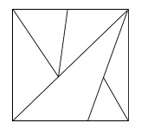
Name the corners A (top-left), B (top-right), C (bottom-right), D (bottom-left).
Inside the square the diagonal BD is drawn. A line from A, and a line from a point P on the top edge, both run down to V, the point where they meet that diagonal.
On the right, a line runs from B to a point E on the bottom edge, and a short line joins C to a point F on BE.
Above the diagonal: APV, PBV, AVD, then ABV (which is APV plus PBV) and the whole of ABD. That is 5.
Below it: BDE, then BEC, which CF cuts into BFC and FEC, and BDC itself. That is 5.
5 + 5 = 10 → option (c).
Why the others are wrong
- (a)9 — 9 is one short. The pieces easiest to miss are the middle-sized ones: ABV above the diagonal and BEC below it are each built from two smaller triangles, and each is a triangle in its own right.
- (b)8 — 8 is what you get by counting the six smallest cells and adding only the two halves ABD and BDC. It misses ABV and BEC, the two composites that sit between those sizes.
- (d)11 — 11 counts one shape too many. A region such as A–P–V–D is bounded by four segments — AP along the top edge, PV, VD along the diagonal and DA down the left side — so it is a quadrilateral, not a triangle.
Concept
Counting triangles goes wrong when it is done by eye. Do it by size class instead.
First list the smallest cells, the ones no line crosses: APV, PBV, AVD, BDE, BFC and FEC. Six.
Then list the composites, each made of smaller cells but still bounded by three straight sides: ABV, BEC, ABD and BDC. Four.
Six plus four is ten, and the method also tells you when to stop, because there is no larger union left whose boundary is a triangle.
The figure is an image and prints small. Two details decide the count: the point V, which lies on the diagonal itself, and the short line from C, which meets BE rather than reaching the diagonal.
Key facts
- Six of the ten are the smallest cells: APV, PBV, AVD, BDE, BFC and FEC.
- Four are composites: ABV, ABD, BEC and BDC.
- The diagonal BD cuts the square into two triangles that hold five each.
Study next
Common traps
- Counting only the smallest cells and stopping at six.
- Treating the four-cornered region APVD as a triangle.
- Missing BDE, which needs part of the bottom edge and the whole of the diagonal.
The question is printed in one line with no labels on the figure, so the first move is always to letter the corners yourself.
13 Sep 2024, 12:30, Reasoning Q.20 asks it in exactly the same words over a different figure.
Related PYQs
No directly related past PYQ was found.