
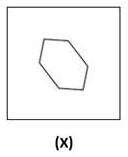
Select the option figure in which the given figure (X) is embedded (rotation is NOT allowed).
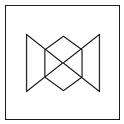
- (a)
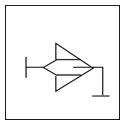
- (b)
- (c)
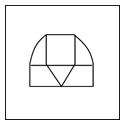
- (d)
Answer
Why
Correct — D.
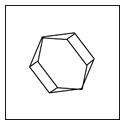
Figure (X) is a single closed six-sided outline, tilted.
Reading round it: a long top edge sloping gently down to the right, then a long edge falling to the right, a short near-vertical edge.
Then a flat bottom edge, a long edge climbing back up to the left, and a short edge closing at the top.
Option (d) is a hexagonal band — an outer hexagon and an inner hexagon joined corner to corner, so that the whole thing reads as six bars.
Trace the inner hexagon of that band and you are tracing (X): the same six edges, in the same directions, at the same size and the same tilt.
Nothing has to be turned, which is what the instruction requires → option (d).
Why the others are wrong
- (a)This is a zigzag of diamonds slung between two vertical bars. Place (X) anywhere on it and under half of the hexagon's outline lands on a drawn line; there is no flat bottom edge for (X) to rest on.
- (b)An arrowhead figure with two triangles, a diamond and free-standing bars at either end. Its long runs are the two sides of the arrowhead, and most of (X)'s outline falls on blank paper wherever you put it.
- (c)Two curved arcs rise over a rectangle here. Figure (X) has no curve anywhere in it, and a straight edge cannot be made to lie along an arc.
Concept
Embedded-figure items ask whether the target appears inside an option unchanged. The rider in brackets, rotation is NOT allowed, means the answer must contain (X) at the same tilt, so mentally turning shapes is wasted effort.
The fast method is to pick one feature of the target that is hard to fake and hunt only for that. Here it is the flat bottom edge with a short, almost vertical edge rising from its right end.
The reason (d) is easy to miss is that (X) is not sitting in open space inside it. It forms the inner boundary of the band, with a second hexagon drawn a short distance outside it, so the target's edges look thickened rather than separate.
The figures are images. If they fail to load, the description above is what the card is teaching: a six-sided outline, and an option that draws that outline twice with the corners joined.
Key facts
- Figure (X) is a closed six-sided outline with one flat bottom edge and no curved parts.
- In option (d) the inner hexagon of the band is figure (X), at the same size and the same tilt.
- The instruction rotation is NOT allowed means the target must be found without turning it.
Study next
Common traps
- Turning (X) in your head, which the instruction forbids.
- Rejecting option (d) because the band's second hexagon makes the outline look thicker than (X).
- Matching on general shape rather than checking that every one of the six edges lies on a drawn line.
11 Sep 2024, 12:30, Reasoning Q.18 and 09 Sep 2024, 16:00, Reasoning Q.6 print the same sentence, brackets included.
It also appears at 25 Sep 2024, 09:00, Reasoning Q.4, so the rotation rider is worth reading once and then trusting.
Related PYQs
No directly related past PYQ was found.