
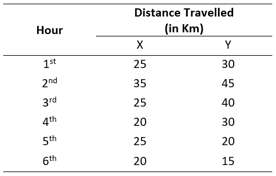
The table given here represents the distance (in km) travelled by two athletes X and Y in the same direction. Y’s average speed (km/hour) during the first five hours is:
- (a)31
- (b)34
- (c)32
- (d)33
Answer
Why
Correct — D. The figure is a table of distances covered hour by hour, with one column for X and one for Y over six hours.
Read Y's column, hours 1 to 5: 30, 45, 40, 30, 20. Running total:
30 + 45 = 75
75 + 40 = 115
115 + 30 = 145
145 + 20 = 165 km
Average speed = total distance ÷ total time = 165 ÷ 5 = 33 km/h → option (d)
Why the others are wrong
- (a)31 — 31 km/h needs a five-hour total of 155 km. Y's first five entries come to 165, so 31 is what you get after losing 10 km somewhere in the column.
- (b)34 — 34 km/h needs 170 km, 5 km more than Y covers. The slip that produces it is reading the fifth hour's 20 as 25 — the value in X's column on that row.
- (c)32 — 32 km/h needs 160 km, which is hours 1 to 4 plus the sixth hour's 15 km. It is the total you reach by skipping the fifth row rather than stopping at it.
Concept
Average speed is total distance ÷ total time, never the average of the separate speeds — unless every interval is the same length.
Here they are: each row covers exactly one hour, so adding the five distances and dividing by 5 is legitimate, and it agrees with the definition.
The real difficulty is the reading. Two columns of numbers, six rows, and the question wants one column and five of its rows.
X's column is there to be taken by mistake. X's first five hours total 130 km, an average of 26 km/h, which is not among the options — so the wrong column costs the time twice over.
Key facts
- Average speed is total distance divided by total time.
- Y covers 30, 45, 40, 30 and 20 km in its first five hours.
- Those distances add to 165 km, and 165 ÷ 5 = 33 km/h.
- Because every row spans one hour, the mean of the hourly distances equals the average speed here.
Study next
Common traps
- Including the sixth hour and still dividing by five.
- Reading X's column instead of Y's.
- Carrying the equal-interval shortcut into a problem whose legs differ in length.
The same phrase does different work depending on the intervals.
At 10 Sep 2024, 09:00, Quant Q.17 a bus covers three fractions of a route at 40, 50 and 60 km/h. There averaging the speeds is simply wrong — only total over total survives, which is why its answer is 48.65 km/h.
Here the rows are equal hours, so the two agree. Weighted averaging of a different kind sits at 11 Sep 2024, 16:00, Quant Q.9, where 12 students average 62 and the rest 74.
Related PYQs
No directly related past PYQ was found.