
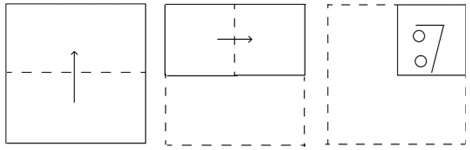
A paper is folded and cut as shown below. How will it appear when unfolded?
- (a)
- (b)
- (c)
- (d)
Answer
Why
Correct — A.
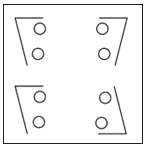
The sheet is folded twice, bottom half upward and then left half to the right, so the cutting happens on the top-right quarter.
That quarter carries a short straight bar, a slanting line dropping from the bar's right end towards the lower left, and two small circles to the left of the slant.
Unfolding reverses the folds in turn. Opening the vertical crease copies the motif into the top-left quarter as a left-right mirror. Opening the horizontal crease copies the whole top half downwards as a top-to-bottom mirror.
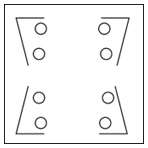
Option (a) shows both: the two upper motifs face each other, and the two lower motifs are that pair turned upside down, their straight bars now lying along the bottom.
Why the others are wrong
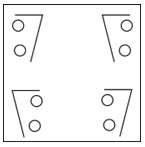
- (b)The lower motifs keep their straight bar along the top, so the bottom half is a plain copy of the top half rather than its upside-down mirror.
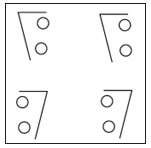
- (c)The same motif is repeated in both upper quarters rather than mirrored across the vertical crease, and the lower half is again left unflipped.
- (d)Only the bottom-right quarter is flipped. The bottom-left motif still carries its bar along the top, so one crease has been opened inconsistently.
Concept
Every fold is a mirror line, and unfolding replays those lines backwards. Two folds therefore produce four copies of whatever was cut, related by reflection in the two creases.
First work out which quarter was cut. An upward fold leaves the working sheet in the top half; a left-to-right fold then leaves it in the top-right quarter.
Now reflect that quarter across the vertical crease, and reflect the resulting half across the horizontal crease. A feature near the top of the packet lands near the bottom of the lower copies, which is why the straight bars change ends.
Reflections, not slides: a copy that merely shifts down the sheet is the commonest wrong drawing offered.
All four options carry eight circles and four line motifs, so counting the cuts settles nothing. Only the orientation of the four motifs separates them.
Key facts
- Each fold doubles the pattern, so two folds give four copies.
- Unfolding is reflection in the crease, so a mark near a crease stays near it and a mark near an edge stays near that edge.
- The final packet here is the top-right quarter, because the sheet was folded bottom-up and then left-to-right.
Study next
Common traps
- Sliding the pattern into the other quarters instead of reflecting it
- Opening one crease and forgetting the second, which leaves the lower half unflipped
- Misreading the fold arrows and cutting on the bottom-left quarter instead
The folds are shown by arrows on the figure rather than described in words, so the direction of each fold has to be read off the drawing. The same format is set at Reasoning Q.23 of the 11 Sep 2024, 12:30 shift and at Reasoning Q.15 and Q.18 of the 11 Sep 2024, 09:00 shift.
Related PYQs
No directly related past PYQ was found.