
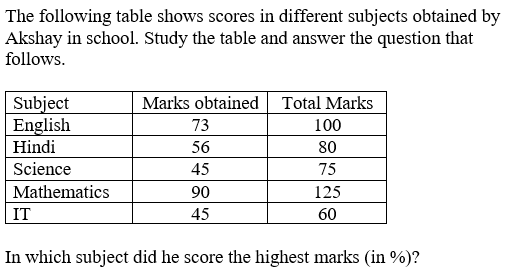
The following table shows scores in different subjects obtained by Akshay in school. Study the table and answer the question that follows. Subject → Marks obtained | Total Marks English — 73 | 100 Hindi — 56 | 80 Science — 45 | 75 Mathematics — 90 | 125 IT — 45 | 60 In which subject did he score the highest marks (in %)?
- (a)Mathematics
- (b)IT
- (c)English
- (d)Hindi
Answer
Why
Correct — B. The stem is a table image. Akshay's marks, against the total for each subject: English 73 of 100, Hindi 56 of 80, Science 45 of 75, Mathematics 90 of 125, IT 45 of 60.
The question asks for the highest percentage, not the highest mark, and every subject is out of a different total.
English: 73 ⁄ 100 = 73%
Hindi: 56 ⁄ 80 = 70%
Science: 45 ⁄ 75 = 60%
Mathematics: 90 ⁄ 125 = 72%
IT: 45 ⁄ 60 = 75%
75% is the largest of the five, so the subject is IT → option (b).
Why the others are wrong
- (a)Mathematics — Mathematics carries the highest raw mark, 90, which is exactly the bait. It is out of 125, the largest total on the table, so it converts to 72% and finishes third.
- (c)English — English is out of 100, so its mark and its percentage are the same number, 73. That reads convincingly high until you notice 45 out of 60 is three-quarters.
- (d)Hindi — Hindi's 56 out of 80 is 70%, the second-lowest percentage on the table. A mark in the fifties beside a total of 80 flatters itself.
Concept
Every row of this table has a different denominator, and that is the entire question. A ranking by marks and a ranking by percentage are different rankings.
Convert, do not eyeball. Two shortcuts save time here: a total of 100 makes the mark its own percentage, and 45 ⁄ 60 reduces to 3 ⁄ 4, which is 75% without any division.
To compare two fractions without converting either, cross-multiply: for 73 ⁄ 100 against 45 ⁄ 60, compare 73 × 60 = 4380 with 45 × 100 = 4500, so 45 ⁄ 60 is larger.
By marks the order is Mathematics, English, Hindi, then Science and IT tied at 45.
By percentage it is IT, English, Mathematics, Hindi, Science. Almost nothing keeps its place.
Key facts
- 45 out of 60 reduces to 3 ⁄ 4, which is 75%.
- 90 out of 125 is 72%, since 125 × 0.72 = 90.
- A score out of 100 makes the mark and the percentage the same number.
- Cross-multiplication compares two fractions without dividing either of them.
Study next
Common traps
- Picking the subject with the highest raw mark
- Assuming every subject is out of the same total
- Judging 90 out of 125 as roughly three-quarters by eye
SSC prints a five-row table and asks a single question off it — highest or lowest percentage, or the gap between two subjects. The intended error is answering from the marks column, so the totals column is where the question actually lives.
Related PYQs
No directly related past PYQ was found.