
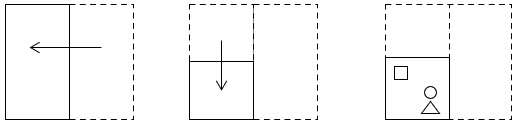
A paper is folded and cut as shown below. How will it appear when unfolded?
- (a)
- (b)
- (c)
- (d)
Answer
Why
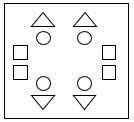
Correct — B. Rule: undo the folds in reverse order, mirroring every cut across each fold line.
The sheet is folded right half onto left, then top half down onto bottom, leaving the bottom-left quarter. That quarter carries a small square near the fold corner, a circle below it, and a triangle pointing up near the bottom edge.
Undo the horizontal fold first: every cut is mirrored upward across the horizontal midline, so the upright triangle reappears pointing down near the top edge.
Undo the vertical fold: the whole left half is mirrored across the vertical midline, giving four copies of each shape.
Option (b) is that sheet — squares stacked in pairs across the horizontal midline at each side edge, circles inside them, triangles pointing down at the top and up at the bottom.
Why the others are wrong
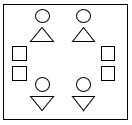
- (a)The top half puts the circle outside the triangle while the bottom half puts the triangle outside. An unfold is symmetric about the horizontal midline, so the two halves cannot differ in order.
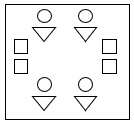
- (c)All four triangles point down, including the two in the lower half. Those two are the original cuts, which point up and are not touched by any mirror.
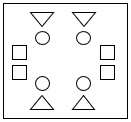
- (d)The triangles point up at the top and down at the bottom, the reverse of the fold. The cut points up in the folded quarter, so it stays up below and flips only above.
Concept
Paper folding is two mirror operations run backwards: unfold the last fold first, mirroring every cut across that fold line, then unfold the one before it.
Two perpendicular folds mean four copies of every cut, placed symmetrically about both midlines. Shapes with mirror symmetry — the square and the circle here — look identical after flipping, so they tell you where the cuts are but not which way they face.
The triangle is the deciding shape. It has no horizontal mirror symmetry, so it flips when the horizontal fold is undone and keeps its direction when the vertical fold is undone.
Every option shows four of each shape in roughly the same places, so counting will not separate them. Only triangle direction and the order of circle and triangle within a half decide the answer.
Key facts
- Two folds produce four copies of each cut, one per quadrant.
- The folded quarter is the bottom-left one, holding a square, a circle and an upward-pointing triangle.
- Mirroring across a horizontal line turns an upward triangle downward, while mirroring across a vertical line leaves it pointing up.
Study next
Common traps
- Flipping all four triangles, or none of them
- Forgetting that the cuts in the folded quarter itself stay exactly as drawn
- Reading the arrows as the direction the paper opens rather than the direction it folds
Paper folding is a regular figural item. In this paper it sits beside a mirror-image question at 11 Sep 2024, 12:30, Reasoning Q.10 and figure series at Q.15 and Q.20.
Related PYQs
No directly related past PYQ was found.