
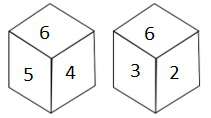
Two different positions of the same dice are given below. Which is the number on the face opposite the face containing 1?
- (a)6
- (b)4
- (c)5
- (d)3
Answer
Why
Correct — A. Rule: two faces visible in the same view can never be opposite each other.
The first view shows 6, 5 and 4 together. The second shows 6, 3 and 2 together.
So 6 is adjacent to 5, 4, 3 and 2 — four distinct faces.
A cube has six faces: four neighbours and one opposite. With 2, 3, 4 and 5 all neighbouring 6, the only face left to lie opposite 6 is 1.
Opposition works both ways, so the face opposite 1 is 6 — option (a).
Why the others are wrong
- (b)4 — 4 appears beside 6 in the first view, so it belongs to the ring of four faces around the 1-6 axis and touches 1 instead of facing it.
- (c)5 — 5 sits with 6 in the first view. Every face adjacent to 6 is also adjacent to 1, because 1 and 6 are the opposite pair.
- (d)3 — 3 shares the second view with 6, which puts it in the same ring of neighbours, so it cannot be the face opposite 1.
Concept
Two-view dice questions are usually settled by adjacency, not by rotating the cube in your head.
List every face that shares a view with a given face — those are its neighbours. Once a face has four distinct neighbours, the one number still unlisted must be its opposite.
Here 6 is common to both views, so its neighbours accumulate across the two pictures (5 and 4 from the first, 3 and 2 from the second) instead of stopping at three.
If no face were shared between the two views, the neighbour count would not close this quickly and you would have to align the cubes by rotation.
Key facts
- View 1 shows 6 on top with 5 and 4 on the visible sides.
- View 2 shows 6 on top with 3 and 2 on the visible sides.
- A cube face has exactly four neighbours and one opposite, so 6 neighbouring 2, 3, 4 and 5 forces 6 opposite 1.
Study next
Common traps
- Trying to rotate the two cubes into alignment when a neighbour count answers it outright
- Relying on the habit that opposite faces sum to 7, which happens to agree here but is not what the pictures prove
- Misreading the top face of the second view as a different number from the first
Dice sit in the figural block with mirror images and paper folding, both of which this shift also asks, at 11 Sep 2024, 12:30, Reasoning Q.10 and Q.23.
Related PYQs
No directly related past PYQ was found.