
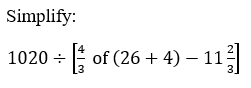
Simplify: 1020 ÷ [4⁄3 of (26 + 4) − 11 2⁄3]
- (a)17
- (b)28
- (c)31
- (d)36
Answer
Why
Correct — D. The stem is an image. It reads: Simplify 1020 ÷ [4⁄3 of (26 + 4) − 11⅔].
Work the bracket first, innermost part first.
(26 + 4) = 30
4⁄3 of 30 = 4 × 30 ÷ 3 = 40
Convert the mixed number, then subtract:
11⅔ = 35⁄3
40 − 35⁄3 = (120 − 35)⁄3 = 85⁄3
Now the division, turning the fraction over:
1020 ÷ 85⁄3 = 1020 × 3⁄85
1020 ÷ 85 = 12, so 12 × 3 = 36 → option (d).
Why the others are wrong
- (a)17 — 17 requires the bracket to be 1020 ÷ 17 = 60. The bracket is 40 − 11⅔ = 28⅓, so 60 cannot come out of it however the terms are grouped.
- (b)28 — 28 is the bracket, not the answer — 85⁄3 = 28.33, rounded down. The expression still has to be divided into 1020 before you stop.
- (c)31 — 31 would need the bracket to be 1020 ÷ 31 ≈ 32.9. The bracket evaluates to 28⅓, and 1020 is an exact multiple of 85, so the quotient lands cleanly on 36.
Concept
BODMAS fixes the order: brackets, then "of", then division and multiplication left to right, then addition and subtraction. Everything contested here sits inside one bracket, so the order inside it decides the answer.
Two conversions do the work. "of" means multiply, so 4⁄3 of 30 is 40. And a mixed number must become an improper fraction before you subtract, so 11⅔ becomes 35⁄3.
Once the bracket collapses to 85⁄3, dividing by a fraction is multiplying by its reciprocal.
The expression is delivered as a picture because of the fraction bars, so mis-reading 11⅔ as 11 and 2⁄3 separately, or as 11 × 2⁄3, is a real risk before any arithmetic starts.
Key facts
- A mixed number becomes an improper fraction before subtraction: 11⅔ = 35⁄3.
- Dividing by a fraction is multiplying by its reciprocal, so 1020 ÷ 85⁄3 = 1020 × 3⁄85.
- 1020 = 85 × 12, which is what lets 1020 × 3⁄85 collapse to 36 with no long division.
Study next
Common traps
- Subtracting 11⅔ from 30 before multiplying by 4⁄3.
- Reading 11⅔ as 11 × 2⁄3.
- Answering with the value of the bracket and never completing the division.
The numbers are chosen so a correct order of operations gives a clean integer and a mis-ordered one does not. Quant Q.19 of the same shift (11 Sep 2024, 12:30) prints its four options as images instead, so there too the picture has to be read before you commit.
Related PYQs
No directly related past PYQ was found.