
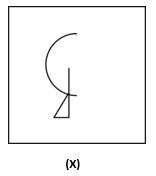
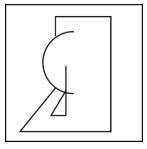
Select the option figure in which the given figure (X) is embedded (rotation is NOT allowed).
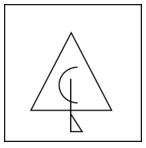
- (a)
- (b)
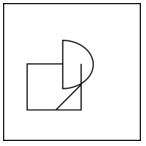
- (c)
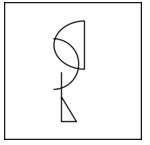
- (d)
Answer
Why
Correct — D. Figure (X) is made of four parts.
a large open arc shaped like a C that opens to the right
a short vertical stroke standing inside the mouth of that arc
a small horizontal tick crossing the stroke at the arc's lower tip
a thin triangle hanging to the left of the stroke, with a flat base at the bottom
Option (d) carries all four, in the same places and the same directions — the C-arc, the stroke, the tick at the same crossing point, and the narrow triangle on the stroke's left — with an extra rectangle and a long diagonal drawn around them.
Since rotation is barred, an option counts only when every line of X keeps its own direction, and option (d) does.
Why the others are wrong
- (a)The thin triangle hangs to the right of the vertical stroke, a mirror of X's triangle. A flipped part is not the same part, and no turning is allowed to fix it.
- (b)There is no thin triangle at all and the curve is a closed half-disc with a straight chord, so X's open C-arc is not present.
- (c)The arc is cut off by a straight chord into a half-disc and the small triangle again sits on the wrong side of the stroke, so two of X's four parts are missing.
Concept
An embedded-figure item is a containment question: does the option contain X line for line, in the same orientation? Nothing may be turned or flipped.
Work from the most distinctive part of X rather than the whole shape. Here that is the thin triangle sitting to the left of the vertical stroke, and scanning only for it removes most options in seconds.
Check the rest only once that part survives: which way the arc opens, whether the arc is open or closed by a chord, and where the tick crosses the stroke.
The source scan is small, so read shapes by their structure rather than their fine detail: open arc against closed half-disc, and which side of the stroke the triangle hangs on. Both survive at low resolution.
Key facts
- Figure X is an open arc, a vertical stroke, a short tick crossing that stroke, and a narrow triangle to the left of it.
- Embedding means the same lines in the same directions, so a mirrored part fails as surely as a rotated one.
- Options (a) and (c) both place the small triangle on the opposite side of the stroke from X's.
Study next
Common traps
- Matching on the arc alone, when every option shows a curve of some kind
- Accepting a mentally rotated or mirrored match when the instruction forbids it
- Overlooking where the tick crosses the stroke
Figure-based reasoning recurs through this shift — among the items it takes in are 11 Sep 2024, 12:30, Reasoning Q.15 and Q.20 (figure series), Q.23 (paper folding) and Q.10 (mirror image).
Related PYQs
No directly related past PYQ was found.