
The value of the expression (1.55² + 0.55² + 1.55 × 0.55) is equal to:

- (a)
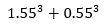
- (b)
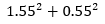
- (c)
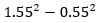
- (d)
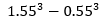
Answer
Why
Correct — D. The expression is the second factor of the difference of cubes.
a³ − b³ = (a − b)(a² + ab + b²)
With a = 1.55 and b = 0.55, a − b = 1.
So a² + ab + b² = (a³ − b³) ÷ 1 = a³ − b³, which is option (d).
Check: 2.4025 + 0.3025 + 0.8525 = 3.5575, and 1.55³ − 0.55³ = 3.723875 − 0.166375 = 3.5575.
Why the others are wrong
- (a)Option (a) is the sum of cubes, and its factorisation (a + b)(a² − ab + b²) needs a minus on the middle term. Its value is 3.890250, not 3.5575.
- (b)Option (b) drops the ab term. Since 1.55 × 0.55 = 0.8525, option (b) comes to 2.7050 while the expression in the question is 3.5575.
- (c)Option (c) is the difference of squares, (a + b)(a − b) = 2.10 × 1 = 2.10. The expression has a plus between the squares and an extra ab term on top.
Concept
Two standard identities differ only by the sign in the middle:
a³ − b³ = (a − b)(a² + ab + b²)
a³ + b³ = (a + b)(a² − ab + b²)
A plus in front of ab points to the difference of cubes. SSC then picks numbers with a − b = 1, so the bracket you are handed is the whole of a³ − b³ and no multiplication is left to do.
Spotting that 1.55 − 0.55 = 1 is the entire question.
The four options are printed as images. Reading (a) to (d) they are 1.55³ + 0.55³, 1.55² + 0.55², 1.55² − 0.55² and 1.55³ − 0.55³.
Key facts
- a³ − b³ = (a − b)(a² + ab + b²).
- 1.55 − 0.55 = 1, which is why the bracket equals a³ − b³ exactly here.
- 1.55² + 0.55² + 1.55 × 0.55 = 3.5575.
Study next
Common traps
- Choosing the sum of cubes because every sign in the expression is a plus.
- Multiplying the decimals out and then finding no option in that form.
- Forgetting the shortcut works only because a − b happens to be 1.
SSC asks this identity in both directions. Quant Q.16 of this same shift gives you (4.2³ − 1.2³) ⁄ (4.2² + 5.04 + 1.2²) and wants the quotient a − b.
Related PYQs
No directly related past PYQ was found.