
How many triangles are there in the given figure?
- (a)9
- (b)10
- (c)8
- (d)11
Answer
Why
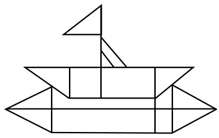
Correct — D. Rule: count region by region, then add. The boat forms triangles in four places.
Flag: the pennant is one right triangle standing against the mast. 1
Sail: two diagonals drop from the mast to the deck line, each closing a triangle with the mast and the deck. They run parallel and never cross, so they give 2.
Upper hull: its left and right wings are each a triangle cut off by a vertical line. 2
Hull points: the sharp left point and the sharp right point are triangles, and the long horizontal running the width of the boat halves each of them. 3 + 3 = 6
1 + 2 + 2 + 6 = 11, which is option (d).
Why the others are wrong
- (a)9 — Nine is two short. The pair most easily lost are the two wings of the upper hull — each a triangle closed by a vertical — because they read as part of the boat's outline.
- (b)10 — Ten is one short. The shorter of the two sail diagonals closes its own triangle against the mast and the deck exactly as the longer one does, and it is the easiest to drop.
- (c)8 — Eight is three short. It is where you land if you take only the two halves either side of the horizontal at each hull point, never the whole point, and miss a sail triangle as well.
Concept
Triangle counting is a search, not an eye test. Split the picture into regions that share no lines, count inside each, then add — and count composite triangles, not only the smallest cells.
This figure splits cleanly into four: the pennant, the sail, the upper hull and the two pointed ends of the lower hull.
The full-width horizontal running through the boat is what most counts get wrong. It passes through both pointed ends, so each end yields three triangles — the whole point and its two halves — rather than one.
Nothing in the boat's rectangular panels is a triangle: the mast and the verticals inside the hull only produce rectangles. Everything countable sits at the flag, the sail and the four sloping ends.
Key facts
- The figure yields 11 triangles: 1 at the flag, 2 in the sail, 2 in the upper hull and 6 across the two hull points.
- The full-width horizontal turns each pointed end of the hull into three triangles rather than one.
- The two sail diagonals are parallel and meet the deck at different points, so they close two nested triangles and not three.
Study next
Common traps
- Counting only the smallest cells and missing composites built from two of them
- Reading the parallel sail diagonals as if they crossed, which invents a third triangle
- Forgetting that the full-width horizontal cuts both pointed ends of the hull
The figure is drawn as a recognisable object, which invites you to read the picture instead of the lines. The same stem appears at 9 Sep 2024, 9:00, Reasoning Q.19 and at 9 Sep 2024, 12:30, Reasoning Q.1.
Related PYQs
No directly related past PYQ was found.