
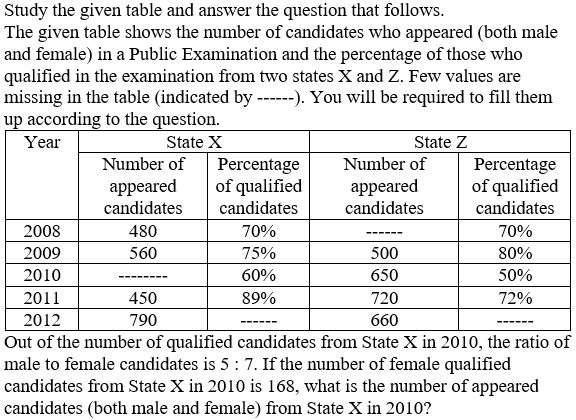
Study the given table and answer the question that follows. The given table shows the number of candidates who appeared (both male and female) in a Public Examination and the percentage of those who qualified in the examination from two states X and Z. Few values are missing in the table (indicated by ------). You will be required to fill them up according to the question. Year → State X: Number of appeared candidates | State X: Percentage of qualified candidates | State Z: Number of appeared candidates | State Z: Percentage of qualified candidates 2008 — 480 | 70% | ------ | 70% 2009 — 560 | 75% | 500 | 80% 2010 — ------ | 60% | 650 | 50% 2011 — 450 | 89% | 720 | 72% 2012 — 790 | ------ | 660 | ------ Out of the number of qualified candidates from State X in 2010, the ratio of male to female candidates is 5 : 7. If the number of female qualified candidates from State X in 2010 is 168, what is the number of appeared candidates (both male and female) from State X in 2010?
- (a)480
- (b)640
- (c)540
- (d)360
Answer
Why
Correct — A. The table leaves the 2010 State X appeared figure blank but prints its qualifying rate as 60%, so work backwards from the 168 qualified female candidates.
Male : female among the qualified = 5 : 7, so females are 7/12 of them
7/12 × qualified = 168 → qualified = 168 × 12/7 = 288
Qualified is 60% of appeared: 0.60 × appeared = 288
appeared = 288 ÷ 0.60 = 480 → option (a).
Why the others are wrong
- (b)640 — 640 appeared would qualify 384 at 60%, and 7/12 of 384 is 224 female candidates, not the 168 the question fixes.
- (c)540 — 540 appeared gives 324 qualified at 60%, whose 7/12 is 189 females — still above the stated 168.
- (d)360 — 360 appeared gives only 216 qualified, i.e. 126 females at 7/12. That undershoots 168, so the base is too small.
Concept
Two reversals sit inside one question: a part back to a whole through a ratio, then a percentage back to its base.
The 5 : 7 male-to-female split fixes the shape of the qualified group before its size is known. 168 females fill 7 parts, so one part is 24 and all 12 parts come to 288.
The table then supplies the rate, 60%. The qualified count is the part and the appeared count is the base, and base = part ÷ rate — so you divide here, you do not multiply.
The 2008 State X row also reads 480 appeared candidates. That is a coincidence of this table and not a shortcut — the 2008 row carries a 70% qualifying rate and says nothing about 2010.
Key facts
- In the table, the State X 2010 row shows a blank for appeared candidates and 60% qualified.
- A 5 : 7 male-to-female split puts females at 7/12 of the qualified group, so 168 females mean 288 qualified.
- Base = part ÷ rate: 288 ÷ 0.60 = 480 appeared candidates.
Study next
Common traps
- Multiplying by 60% instead of dividing, which gives 172.8 and matches no option
- Treating the 5 : 7 ratio as a split of the appeared candidates rather than the qualified ones
- Taking 168 as 5 parts instead of 7, which inflates the qualified total to 403.2
SSC hides one cell of a data table and makes the question itself supply the missing link, here a 5 : 7 gender ratio that no row of the table carries.
A table also drives Quant Q.21 of this shift, where every cell is printed and the question asks for a column average.
Related PYQs
No directly related past PYQ was found.