
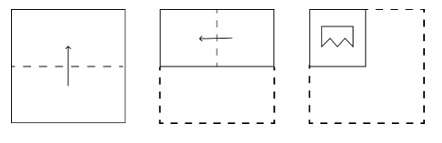
A paper is folded and cut as shown below. How will it appear when unfolded?
- (a)
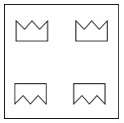
- (b)
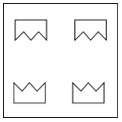
- (c)
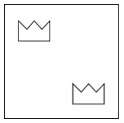
- (d)
Answer
Why
Correct — B. Rule: the quarter you are shown is the top-left quarter — the first arrow folds the bottom half up, the second folds the right half left.
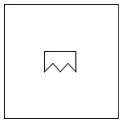
Its cut is a bookmark: a straight top edge, two straight sides, and a triangular notch bitten up into the bottom edge, leaving two downward prongs.
Undoing the vertical fold copies that bookmark into the top-right quarter. Undoing the horizontal fold copies both into the bottom half upside down — notch on top, prongs pointing up.
Option (b) is the sheet with prongs down across the top row and prongs up across the bottom row.
Why the others are wrong
- (a)The right shapes in the wrong halves: here the prongs point up in the top row and down in the bottom row, which is what unfolding gives if the surviving quarter had been a bottom one.
- (c)Carries two bookmarks rather than four, and both sit prongs-up. Two folds make four layers, so one cut through the stack has to reappear four times.
- (d)One shape at the centre of the sheet. A cut made through a folded stack cannot survive as a single mark, because each fold doubles it.
Concept
A folded-and-cut item is a counting question before it is a drawing question. Two folds put four layers under the scissors, so one closed cut opens out as four closed cuts.
Their arrangement is fixed by the fold lines. The quarter that stayed on top keeps the cut as drawn; its neighbour across the vertical fold is a left-right mirror; the two below are top-bottom mirrors of those. When the cut is itself symmetric about the vertical axis, only the top-bottom flip is visible in the answer.
The bookmark here is left-right symmetric, so the vertical unfold leaves it looking identical — which is why the top row of the answer shows two shapes that appear the same. The horizontal unfold is the one you can see.
Key facts
- Two folds make four layers, so one cut through the stack opens out as four cuts.
- The quarter that remained on top reproduces the cut exactly, with no reflection.
- A cut symmetric about the vertical fold line looks unchanged after the vertical unfold.
- The horizontal unfold moves a notch from the bottom edge of a shape to its top edge.
Study next
Common traps
- Reading the second arrow backwards and unfolding about the wrong vertical half.
- Flipping every copy, when the quarter that stayed on top must be left as drawn.
- Matching the notch shape and never checking that four copies are present.
The stem is standing wording, reused verbatim across shifts — also at 11 Sep 2024, 12:30, Reasoning Q.23; 13 Sep 2024, 12:30, Reasoning Q.9; and 18 Sep 2024, 12:30, Reasoning Q.11 and Reasoning Q.20. Reasoning Q.15 of the same paper folds bottom-up and then left-to-right.
Related PYQs
No directly related past PYQ was found.