
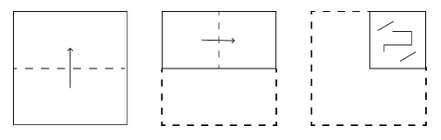
A paper is folded and cut as shown below. How will it appear when unfolded?
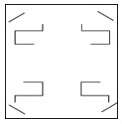
- (a)
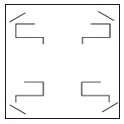
- (b)
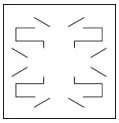
- (c)
- (d)
Answer
Why
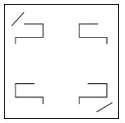
Correct — C. Rule: the quarter you are shown is the top-right quarter of the sheet — the first arrow folds the bottom half up, the second folds the left half right.
That quarter carries three cuts: an S-shaped bracket, with one diagonal slit above it and one below it, both rising to the right.
Unfolding mirrors the quarter across the vertical fold line, then mirrors the whole top half across the horizontal one. The open sheet must therefore show four brackets and eight slits.
Only option (c) shows eight slits, and its top-right quarter repeats the cut piece unchanged.
Why the others are wrong
- (a)Each quarter here carries one diagonal slit rather than two, so the sheet shows four where eight are needed. The bracket in its top-right quarter is also flipped top-to-bottom against the cut piece.
- (b)The brackets are right, but again one slit per quarter instead of two. The slit in its top-right quarter also falls to the right, while both slits on the cut piece rise to the right.
- (d)The whole sheet carries two diagonal slits, at the top-left and bottom-right corners. Two folds force a pattern that mirrors about both fold lines, and this one does not.
Concept
A folded-and-cut item is read backwards. Each fold halves the sheet, so a cut made through the folded stack reappears once in every layer: one fold doubles a cut, two folds quadruple it.
The piece you are shown is the layer that stayed on top. Undo the last fold first — mirror the cut piece across that line — then undo the first fold and mirror the whole result across its line. Counting cut marks usually settles the option before you trace a single shape.
Both arrows point towards the half that survives, so the piece left holding the cuts is the top-right quarter. Read the arrow, not the dashed outline: the dashes mark the half that has been folded away.
Key facts
- Two folds make four layers, so every cut through the stack appears four times on the open sheet.
- The unfolded pattern is mirror-symmetric about each of the two fold lines.
- The quarter that stayed on top reproduces the cut piece exactly, with no reflection.
- Counting cut marks eliminates options faster than matching their shapes.
Study next
Common traps
- Reflecting the cut piece once and producing a half-sheet answer.
- Assuming the surviving quarter is the top-left one when the arrows say otherwise.
- Matching the shape of the cuts and never checking how many there should be.
The stem is standing wording, reused verbatim across shifts — also at 09 Sep 2024, 12:30, Reasoning Q.19; 10 Sep 2024, 09:00, Reasoning Q.23; and 17 Sep 2024, 09:00, Reasoning Q.23. Reasoning Q.18 of the same paper folds the other way, bottom-up then right-to-left.
Related PYQs
No directly related past PYQ was found.