
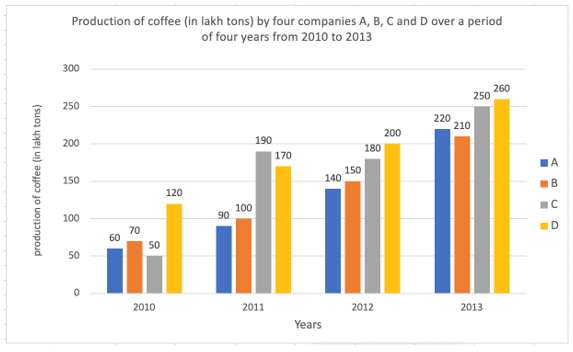
The bar graph below shows the production of coffee (in lakh tons) by four companies A, B, C and D over a period of four years from 2010 to 2013. Study the graph and answer the question that follows. The combined average production for four years of companies A and C is what percentage (rounded off to 2 decimal places) more/less than the combined average production for four years of companies B and D?
- (a)More, 10.51%
- (b)Less, 10.51%
- (c)More, 7.81%
- (d)Less, 7.81%
Answer
Why
Correct — D. Read the four bars for each company off the graph and total them.
A: 60 + 90 + 140 + 220 = 510
C: 50 + 190 + 180 + 250 = 670
A and C together = 1,180, so their four-year average = 1180 ⁄ 4 = 295
B: 70 + 100 + 150 + 210 = 530
D: 120 + 170 + 200 + 260 = 750
B and D together = 1,280, average = 1280 ⁄ 4 = 320
295 is the smaller figure, so the comparison reads 'Less'.
Shortfall = 320 − 295 = 25
25 ⁄ 320 × 100 = 7.8125%, which rounds to 7.81% → option (d)
Why the others are wrong
- (a)More, 10.51% — A and C produce 1,180 lakh tons against B and D's 1,280. A and C are the smaller pair, so the direction is less, not more — the percentage attached to it never gets tested.
- (b)Less, 10.51% — 'Less' is the right direction, but the figure is not: a gap of 25 on the base of 320 is 7.81%, and even taking A and C's 295 as the base gives 8.47%. Neither reading yields 10.51%.
- (c)More, 7.81% — 7.81% is the right size of gap, but it is B and D that are ahead. A and C fall short of them, so 'More' reverses the two pairs.
Concept
Two ideas are welded together here.
First, the combined average: add both companies' output across all four years and divide by 4. The pair is treated as one producer.
Second, the base of the comparison. 'X is what percentage less than Y' always divides the gap by Y — the figure being compared against. Here Y is B and D's 320, not A and C's 295.
Nothing depends on any single year, only on the two four-year totals, so add straight down the graph rather than computing a percentage for each year.
Dividing each pair's total by 8 instead of 4 gives 147.5 and 160 — different averages, the same 7.81%, because both sides are scaled alike.
Key facts
- A and C produce 1,180 lakh tons over 2010–2013, B and D produce 1,280.
- 'A is p% less than B' means (B − A) ⁄ B × 100, with B in the denominator.
- A gap of 25 on a base of 320 is 7.8125%, which the question asks you to round to 7.81%.
- The same gap taken on the base 295 would be 8.47%, so the base choice changes the answer.
Study next
Common traps
- Dividing one pair's total by 8 and the other's by 4.
- Putting the smaller total in the denominator, which turns 7.81% into 8.47%.
- Getting the percentage right and then ticking the 'More' version of it.
SSC hangs a single arithmetic step off a bar graph — an average, a ratio, or a percentage gap. The difference-between-averages reading is asked at 13 Sep 2024, 09:00, Quant Q.16 and again, in the same words, at 26 Sep 2024, 12:30, Quant Q.22.
The pie-chart form of the same skill follows at Quant Q.14 of this shift.
Related PYQs
No directly related past PYQ was found.