
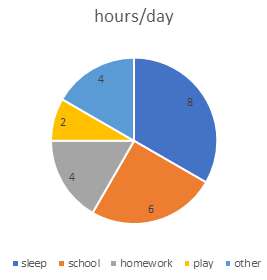
The pie chart given below shows the number of hours spent by a student for different activities on a working day. The percentage of hours spent at school in a day is _____.
- (a)30%
- (b)35%
- (c)40%
- (d)25%
Answer
Why
Correct — D. The chart is titled 'hours/day' and its slices are labelled in hours, not percentages, so total them before taking a share.
Slices: sleep 8, school 6, homework 4, play 2, other 4
Total = 8 + 6 + 4 + 2 + 4 = 24 hours — a full day, which confirms the reading
School share = 6 ⁄ 24 = 1⁄4 = 25% → option (d)
Why the others are wrong
- (a)30% — 30% is 6 ⁄ 20 — school hours divided by a day that has lost one of its two 4-hour slices. All five slices belong in the denominator, and together they make 24.
- (b)35% — 35% of a 24-hour day is 8.4 hours, which is more than the chart's largest slice, sleep at 8. No activity here can hold that share.
- (c)40% — 40% would need a denominator of 15 hours (6 ⁄ 15). The five slices sum to a full 24-hour day, and that total is itself the check that you read the labels correctly.
Concept
A pie chart may be labelled in percentages or in raw units. This one carries hours, so a share is that slice divided by the sum of all slices.
The sum is the safety net. Because these are hours in a day, the five values must total 24 — and 8 + 6 + 4 + 2 + 4 does, so no label has been misread.
Percentages convert straight to angles: 6 of 24 hours is one quarter of the pie, which is 90° at the centre.
Two slices are both labelled 4 (homework and other). Dropping one of them while totalling is the single likeliest slip on this item.
Key facts
- The slices read sleep 8, school 6, homework 4, play 2 and other 4 hours.
- The five slices sum to 24 hours, a complete day.
- School takes 6 of 24 hours, which is one quarter, or 25%.
- One quarter of a pie is 90° of its 360°.
Study next
Common traps
- Assuming the numbers printed on the slices are already percentages
- Dropping one slice when totalling, which turns 6 ⁄ 24 into 6 ⁄ 20
- Answering with the hours (6) when the question asks for a percentage
The options step in fives — 25, 30, 35, 40 — so an eyeballed slice is not enough and the exact fraction is required. The same shift asks the same percentage-of-total step off an income table at Quant Q.1.
Related PYQs
No directly related past PYQ was found.