
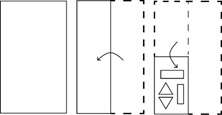
The sequence of folding a paper and the manner in which the folded paper is cut is shown in the following figures. How would this paper look when unfolded?
- (a)
- (b)
- (c)
- (d)
Answer
Why
Correct — A. Read the two folds off the panels, then undo them in reverse order.
Fold 1: the right half is folded onto the left half about a vertical line.
Fold 2: the top of that tall half is folded down onto its bottom about a horizontal line.
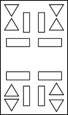
The packet is one quarter of the sheet and carries three cuts: a horizontal bar near the top, a rhombus drawn as an up-triangle sitting on a down-triangle at the lower left, and a tall vertical bar at the lower right.
Rule: unfolding reflects the cuts across each fold line, giving four copies.
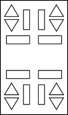
A rhombus is symmetric top to bottom, so the horizontal reflection leaves it looking the same. Every quadrant therefore shows the same rhombus, which is what option (a) has.
Why the others are wrong
- (b)The two upper quadrants show two down-pointing triangles. Reflecting a rhombus about a horizontal fold line returns a rhombus, so the upper quadrants cannot lose their up-pointing triangle.
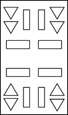
- (c)The upper quadrants here hold two up-pointing triangles. That is what you get by copying the packet's top triangle twice instead of reflecting the whole cut.
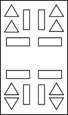
- (d)The upper quadrants read as a bowtie, a down-triangle above an up-triangle. That comes from flipping the two triangles separately rather than reflecting the rhombus as one shape.
Concept
Two folds make four layers, so one cut through the packet leaves four holes in the opened sheet.
Work backwards. Undo the last fold first, reflecting the packet's contents across the horizontal fold line, then undo the first fold, reflecting everything across the vertical line.
Symmetry does most of the work. A cut that is already symmetric about a fold's axis looks identical after that reflection, so only its position moves.
All four options place the horizontal bars in the same spots and give the same lower half.
They differ only in how the two triangles are oriented in the upper quadrants, so that is the single comparison this item needs.
Key facts
- Two perpendicular folds create four layers, so a single cut appears four times on the opened sheet.
- The cut pattern is reflected across each fold line, never slid across it.
- A rhombus is symmetric top to bottom, so a horizontal fold leaves its shape unchanged.
Study next
Common traps
- Repeating the cut pattern by sliding it rather than reflecting it.
- Reflecting the two triangles one at a time, which turns the rhombus into a bowtie.
- Ignoring the curved arrows, which state which half moves at each fold.
SSC draws the folds as small panels with a curved arrow and shows the sheet's original extent as a dashed outline, then makes the four options differ in one detail only.
Mirror images turn on the same reflection idea — also 10 Sep 2024, 16:00, Reasoning Q.11.
Related PYQs
No directly related past PYQ was found.