
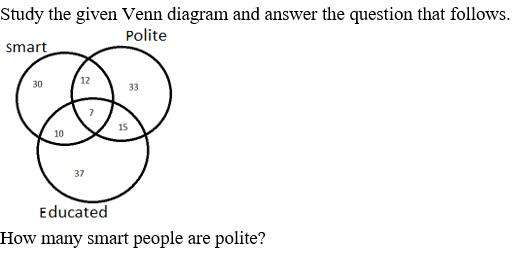
Study the given Venn diagram and answer the question that follows. smart only 30 | smart and Polite 12 | Polite only 33 | smart, Polite and Educated 7 | smart and Educated 10 | Polite and Educated 15 | Educated only 37 How many smart people are polite?
- (a)63
- (b)19
- (c)7
- (d)12
Answer
Why
Correct — B. The question asks for the whole overlap of the smart circle and the Polite circle.
Rule: an overlap of two circles inside a three-circle Venn is made of two regions — the part in just those two, and the part in all three.
In the diagram those two regions are 12 (smart and polite, not educated) and 7 (smart, polite and educated).
12 + 7 = 19, which is option (b).
The other figures — 30, 33, 10, 15 and 37 — all lie outside that overlap.
Why the others are wrong
- (a)63 — 63 is 30 + 33, the smart-only and polite-only regions. Those are precisely the people who are in one circle and not the other.
- (c)7 — 7 is the central region alone, the people who are smart and polite and educated. It leaves out the 12 who are smart and polite but not educated.
- (d)12 — 12 counts the smart and polite who are not educated and drops the central 7, who are just as smart and just as polite.
Concept
'How many smart people are polite?' asks for the entire intersection of two circles, not for one region of it.
A three-circle Venn splits into seven regions. Any two-circle overlap is built from two of them, and both belong in the total whenever the question does not say 'only'.
The safe habit is to shade the region the sentence names before adding anything. Here that means every region lying inside both the smart circle and the Polite circle.
The word 'educated' never appears in the question.
The educated circle still matters, because it cuts the smart-Polite overlap into two pieces — and both pieces are still smart and polite.
Key facts
- The diagram gives 12 people who are smart and polite but not educated.
- It gives 7 people who are smart, polite and educated.
- A two-circle overlap inside a three-circle Venn is always the sum of two regions.
Study next
Common traps
- Reading only the number printed in the two-circle lens and forgetting the centre.
- Adding the two 'only' figures 30 and 33, which counts the people in exactly one circle.
- Answering 7 because the central region looks like the place where everything overlaps.
SSC supplies the diagram as an image with a single-line question under it, so the whole item turns on deciding which regions the sentence names.
The wording is deliberately plain, which is what makes the 'only' variants worth practising alongside it.
Related PYQs
No directly related past PYQ was found.