
If 7 cos² θ + 5 sin² θ − 6 = 0, (0° < θ < 90°), then what is the value of 1 + √((sec θ + tan θ) ⁄ (sec θ − tan θ))?

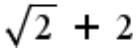
- (a)
- (b)
- (c)
- (d)
Answer
Why
Correct — A. Pin θ first, then clear the surd.
Split 7cos²θ as 5cos²θ + 2cos²θ:
5(sin²θ + cos²θ) + 2cos²θ = 6
5 + 2cos²θ = 6 → cos²θ = 1⁄2
With 0° < θ < 90°, θ = 45°, so sec θ = √2 and tan θ = 1.
(sec θ + tan θ)/(sec θ − tan θ) = (√2 + 1)/(√2 − 1)
Multiply top and bottom by (√2 + 1): = (√2 + 1)² ⁄ 1 = 3 + 2√2
√(3 + 2√2) = √2 + 1
Now add the leading 1: 1 + (√2 + 1) = √2 + 2 → option (a).
Why the others are wrong
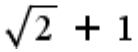
- (b)The square root alone. √((sec θ + tan θ)/(sec θ − tan θ)) really is √2 + 1, but the stem asks for 1 + that root, which is √2 + 2.
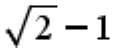
- (c)The fraction inverted. √((sec θ − tan θ)/(sec θ + tan θ)) = √2 − 1, and this option also drops the leading 1 that the expression begins with.
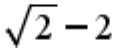
- (d)1 + a square root is never below 1, and √2 − 2 ≈ −0.59 is negative. It is the sign-flipped twin of the keyed value, there to catch a dropped plus.
Concept
Two separate skills sit in one stem.
The first is the Pythagorean identity sin²θ + cos²θ = 1, used to collapse a mixed expression: 7cos²θ + 5sin²θ becomes 5(sin²θ + cos²θ) + 2cos²θ = 5 + 2cos²θ, and the equation solves in one line.
The second is sec²θ − tan²θ = 1, which makes (sec θ + tan θ) and (sec θ − tan θ) reciprocals. Multiplying the fraction top and bottom by (sec θ + tan θ) leaves a perfect square under the root.
cos²θ = 1⁄2 gives cos θ = ±1⁄√2. The stated range 0° < θ < 90° is what selects θ = 45° and spares you a second case.
The surd step is worth learning on its own: √(3 + 2√2) = √2 + 1 because (√2 + 1)² = 2 + 2√2 + 1.
Key facts
- sin²θ + cos²θ = 1, so 7cos²θ + 5sin²θ equals 5 + 2cos²θ.
- sec²θ − tan²θ = 1, so (sec θ + tan θ)(sec θ − tan θ) = 1.
- At θ = 45°, sec θ = √2 and tan θ = 1.
- √(3 + 2√2) = √2 + 1, since (√2 + 1)² = 3 + 2√2.
Study next
Common traps
- Reporting the square root and forgetting the 1 that stands in front of it.
- Trying values of θ by trial instead of collapsing the equation to 5 + 2cos²θ = 6.
- Leaving the answer as √(3 + 2√2) and failing to see it as √2 + 1.
SSC likes an identity-collapse step followed by a substitution, so one careless line ruins both halves.
The same shift runs the pure substitution version at Quant Q.24, where 7 tan θ = 3 has to be pushed through (5 sin θ − cos θ)/(5 sin θ + 2 cos θ).
Related PYQs
No directly related past PYQ was found.