
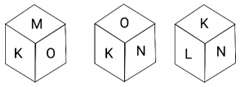
Six letters K, L, M, N, O and P are written on different faces of a dice. Three positions of this dice are shown in the figure. Find the letter on the face opposite to M.
- (a)K
- (b)P
- (c)L
- (d)N
Answer
Why
Correct — D. Three views are drawn, and every face visible in one view is adjacent to the other two in that view.
View 1 shows M, K and O together.
View 2 shows O, K and N together.
View 3 shows K, L and N together.
Rule: a face is opposite the one letter it is never seen beside.
K appears with M, O, N and L — four faces — so K is opposite P, the only letter left.
P is therefore adjacent to everything except K. O is drawn with M, K and N, and is adjacent to P as well, which gives O its four neighbours and fixes O opposite L.
Two pairs are settled, K–P and O–L. Only M and N remain, so M is opposite N — option (d).
Why the others are wrong
- (a)K — Option (a) fails on view 1 alone — M and K are drawn on the same cube, so they are adjacent faces and cannot be opposite each other.
- (b)P — Option (b) puts P opposite M, but P is already spoken for: it is opposite K, because K is seen beside all four of M, O, N and L.
- (c)L — Option (c) is the tempting one, since L never appears beside M. But L is opposite O, once O is shown adjacent to M, K, N and, through the K–P pairing, to P.
Concept
A dice diagram gives you adjacency directly and opposition never. Two faces drawn in the same view are adjacent, and the face you want is the one letter that never shares a view with the target.
Six faces make three opposite pairs. Fix one pair and the problem shrinks, because the face opposite X becomes adjacent to all four remaining faces automatically.
That is the whole method here. K adjacent to four letters fixes K–P, P's forced adjacencies then fix O–L, and M–N falls out with no rotation at all.
All three views are needed and none is spare. K reaches four neighbours only by taking M and O from view 1, N from view 2 and L from view 3 — drop any one view and the dice is no longer determined.
Key facts
- Faces shown in the same view of a dice are adjacent, never opposite.
- K is seen beside M, O, N and L across the three views, which leaves P as the face opposite K.
- The three opposite pairs on this dice are K with P, O with L, and M with N.
Study next
Common traps
- Calling two faces opposite merely because they never appear together, without checking the alternative pair is already taken
- Working from two of the three views, which leaves the dice undetermined
- Rotating the cube mentally when plain adjacency counting settles it
SSC sets dice items with letters as readily as with numbers, and the method does not change.
This very paper carries a numbered two-view version — also asked 10 Sep 2024, 16:00, Reasoning Q.20.
Related PYQs
No directly related past PYQ was found.