
How many squares are there in the given figure?
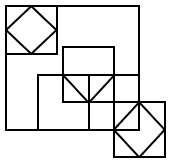
- (a)10
- (b)13
- (c)11
- (d)12
Answer
Why
Correct — B. Count in groups and keep a running total.
Rule: every closed square counts, whatever its size and whatever its tilt.
Corner pieces: a small square at the top left and another at the bottom right, each holding a tilted square drawn on the midpoints of its sides — 4.
The medium square in the middle of the figure — 1.
The ruled region at the lower right: five of the smallest cells are closed on all four sides, and two larger squares span two cells across and two cells down — 7.
The big outer square — 1.
4 + 1 + 7 + 1 = 13, option (b).
Why the others are wrong
- (a)10 — Ten is three short. Drop the two tilted squares as mere diamonds and miss one of the composite squares in the ruled region, and this is the count you reach.
- (c)11 — Eleven is two short. It is what you get by counting every square that is drawn as a complete outline and missing the two composite squares that the ruled lines form.
- (d)12 — Twelve is the near miss, one short. Losing a single composite square, or one tilted square, lands here — which is why the count has to be done by size group.
Concept
Counting figures is bookkeeping, not perception. Count by size group and write the running total down as you go.
Take the smallest closed cells first, then the composites made of two cells across and two down, then the squares drawn as standalone outlines, and finally the whole outer boundary.
Tilted squares are where the count leaks. A square drawn on the midpoints of another square's sides has four equal sides and four right angles, so it is a square, and each corner piece here contains one.
A region only counts if all four of its sides are actually drawn.
Several rectangles in the ruled part of this figure are open on one side, and an open region is not a square at all — which is why five cells count there and not more.
Key facts
- A square rotated through 45 degrees is still a square and has to be counted.
- The figure holds two corner squares, each with a tilted square inscribed on its side midpoints.
- The ruled region contributes five single cells plus two squares that span two cells each way.
- The outer boundary is itself the thirteenth square.
Study next
Common traps
- Treating a tilted square as a diamond and leaving it out of the count.
- Counting a region whose fourth side is not drawn.
- Counting only the smallest cells and never combining them into larger squares.
SSC draws these figures with squares overlapping at the corners so that at least two of the squares are tilted, and offers four consecutive counts as options.
The figure is supplied as an image and the count is the whole of the question, so the marks turn entirely on method.
Related PYQs
No directly related past PYQ was found.