
Six letters A, T, M, P, S and R are written on different faces of a dice. Two positions of this dice are shown in the figure below. Find the letter on the face opposite to the one having R.
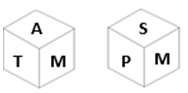
- (a)M
- (b)T
- (c)A
- (d)S
Answer
Why
Correct — A. M shows on the right-hand face in both views, so the dice has only been turned about M.
Rule: every face that appears alongside a given face is adjacent to it, and the face that never appears at all is the one opposite.
View 1 puts A and T beside M. View 2 puts S and P beside M.
That is four different letters — A, T, S and P — all touching M, and a cube face has exactly four neighbours. M's neighbours are complete.
R is the only one of the six letters left, and it appears in neither view. R is opposite M, which is the same as saying M is opposite R — option (a).
Why the others are wrong
- (b)T — T shows beside M in view 1, so T is one of M's four neighbours. R sits opposite M, which leaves T meeting R along an edge instead of facing it.
- (c)A — A is the top face in view 1 while M is on the right. Two faces visible in the same picture share an edge, so A neighbours M and neighbours R as well.
- (d)S — S is the top face in view 2, so it joins A, T and P as M's fourth neighbour. With all four neighbours accounted for, none of them is left to face R.
Concept
When one face repeats across two views, this question is usually solvable without any mental rotation at all.
Collect every letter that appears beside the repeated face. A cube face has exactly four neighbours and one opposite, so as soon as four distinct letters have appeared beside it, the sixth letter must be the opposite one.
Here M repeats, A, T, S and P appear beside it, and R is missing from both pictures.
The question asks for the face opposite R while the shortcut finds the face opposite M. Those are the same statement read from either end, so no extra step is needed.
Key facts
- M is the right-hand face in both views, and A, T, S and P all appear beside it.
- A cube face has four neighbours and exactly one opposite face.
- R appears in neither view, which is what identifies it as M's opposite.
- Two faces visible in the same picture always share an edge.
Study next
Common traps
- Rotating the cube mentally when counting the four neighbours settles it outright
- Assuming the letter missing from both views cannot be placed at all
- Pairing two faces because they sit on opposite sides of the drawing, when both being visible makes them adjacent
SSC's easiest dice pattern is exactly this one: a face repeated in both views and a letter absent from both.
This shift also sets a dice item at Reasoning Q.19, which repeats a face too, but there the ring order has to be read off as well, and 10 Sep 2024, 16:00, Reasoning Q.16 gives three positions.
Related PYQs
No directly related past PYQ was found.