
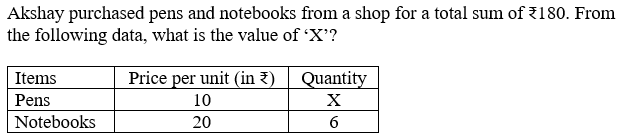
Akshay purchased pens and notebooks from a shop for a total sum of ₹180. From the following data, what is the value of ‘X’? Items → Price per unit (in ₹) | Quantity Pens — 10 | X Notebooks — 20 | 6
- (a)6
- (b)4
- (c)5
- (d)7
Answer
Why
Correct — A. The stem sits in the image: Akshay spent ₹180 in total, the table gives pens at ₹10 each in quantity X and notebooks at ₹20 each in quantity 6. Build the money equation.
Notebooks cost 20 × 6 = ₹120
Pens cost 10 × X = 10X
Total spend: 10X + 120 = 180
10X = 180 − 120 = 60
X = 60 ⁄ 10 = 6 → option (a)
Why the others are wrong
- (b)4 — X = 4 buys only ₹40 of pens, so the bill would come to 40 + 120 = ₹160 — ₹20 short of the ₹180 the question fixes.
- (c)5 — X = 5 gives ₹50 of pens and a total of ₹170. The money left after the notebooks is ₹60, and ₹60 buys six pens, not five.
- (d)7 — X = 7 gives ₹70 of pens and a total of ₹190, which overshoots the ₹180 spent.
Concept
This is a one-unknown linear equation dressed as a table. Each row of the table is a product — price per unit × quantity — and the bill is the sum of those products.
The notebook row is fully known, so it contributes a fixed ₹120 and the unknown survives in one term only. Subtract the known part from the total, then divide by the unit price.
The general shape is 10X + 20(6) = 180; nothing here needs simultaneous equations because only one cell of the table is blank.
The question text is empty in the response sheet because the whole stem, including the two-row table, is printed as an image.
Key facts
- Spend on one item = price per unit × quantity, and the bill is the sum over items.
- One unknown in one equation needs no elimination — strip the known terms, then divide.
- Here ₹180 − ₹120 = ₹60 is the money spent on pens, and ₹60 ⁄ ₹10 = 6 pens.
Study next
Common traps
- Solving 10X = 180 and answering 18, having forgotten the ₹120 of notebooks.
- Adding the price column, 10 + 20 = 30, as though it were a combined rate.
- Reading X as the price of a pen when the column header says Quantity.
SSC hides a single-line equation inside a small table so the item reads as data interpretation rather than algebra. The same shift's Quant Q.9 works the same way — a subject-wise table you must total before any arithmetic begins.
Related PYQs
No directly related past PYQ was found.