
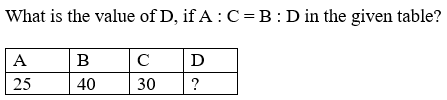
What is the value of D, if A : C = B : D in the given table? A | B | C | D 25 | 40 | 30 | ?
- (a)45
- (b)56
- (c)42
- (d)48
Answer
Why
Correct — D. The table gives A = 25, B = 40, C = 30 and asks for D under A : C = B : D.
25 : 30 = 40 : D
Cross-multiply: 25 × D = 30 × 40 = 1200
D = 1200 ⁄ 25 = 48 → option (d)
Faster route: 25 : 30 reduces to 5 : 6, so D = 40 × 6⁄5 = 48.
Check: 40 : 48 also reduces to 5 : 6, so the two ratios match.
Why the others are wrong
- (a)45 — 45 comes from adding the gap instead of scaling it: 30 − 25 = 5, so 40 + 5 = 45. But 40 : 45 is 8 : 9, not the 5 : 6 that 25 : 30 sets.
- (b)56 — 40 : 56 reduces to 5 : 7, so it cannot equal 25 : 30 = 5 : 6 and the proportion fails.
- (c)42 — 40 : 42 reduces to 20 : 21, almost 1 : 1, whereas 25 : 30 demands a ratio of 5 : 6.
Concept
A proportion A : C = B : D says two ratios are equal, and equal ratios cross-multiply: A × D = B × C.
The pairing is less fragile than it looks. By alternendo, A : C = B : D is equivalent to A : B = C : D, so pairing 25 with 40 and 30 with D returns the same 48. What breaks the answer is inverting one side only.
Reducing the known ratio to lowest terms first — 25 : 30 = 5 : 6 — keeps the arithmetic small enough to do in your head.
The table carries no data beyond the three numbers, so read it as a one-line proportion rather than as a data-interpretation set with rows to compare.
Key facts
- A : C = B : D is equivalent to A × D = B × C.
- Alternendo: a : b = c : d implies a : c = b : d.
- 25 : 30 reduces to 5 : 6, and so does 40 : 48.
- The fourth proportional to a, b and c is bc ⁄ a.
Study next
Common traps
- Adding the difference (40 + 5 = 45) instead of scaling by the ratio.
- Cross-multiplying the wrong pair and getting 25 × 40 ⁄ 30 = 33.3.
SSC also sets the same idea as ratio chaining. At 10 Sep 2024, 12:30, Quant Q.8 you are given A:B = 6:8 and B:C = 5:12 and asked for A:B:C, and at 23 Sep 2024, 12:30, Quant Q.4 the ask is the fourth proportional to 4, 9 and 16.
Related PYQs
No directly related past PYQ was found.