
(2 + tan² 2A + cot² 2A) ⁄ (sec 2A · cosec 2A) is equal to ________.

- (a)

- (b)
- (c)
- (d)

Answer
Why
Correct — A. The stem asks for (2 + tan² 2A + cot² 2A) ⁄ (sec 2A · cosec 2A). Write θ for 2A and split the 2 into 1 + 1.
2 + tan²θ + cot²θ = (1 + tan²θ) + (1 + cot²θ)
= sec²θ + cosec²θ
Now divide each term by sec θ · cosec θ:
sec²θ ⁄ (sec θ · cosec θ) = sec θ ⁄ cosec θ = tan θ
cosec²θ ⁄ (sec θ · cosec θ) = cosec θ ⁄ sec θ = cot θ
tan θ + cot θ = (sin²θ + cos²θ) ⁄ (sin θ cos θ) = 1 ⁄ (sin θ cos θ)
= sec 2A · cosec 2A, the value the key marks as option (a).
Why the others are wrong
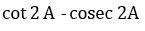
- (b)At 2A = 30° the expression is 1 ⁄ (sin 30° cos 30°) = 2.309. Option (b) is −0.268 read as a difference and 3.464 read as a product, so it fails on either reading of its printed mark.
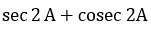
- (c)This cancels one factor from each term separately, which is not allowed: sec²θ + cosec²θ over sec θ · cosec θ leaves tan θ + cot θ. At 2A = 30° the expression is 2.309, while sec + cosec is 3.155.
- (d)The expression is unchanged when tan and cot swap, so its value must treat sin and cos alike. sec 2A + tan 2A does not — at 2A = 30° it is 1.732 against the expression's 2.309.
Concept
Two Pythagorean identities do the work: 1 + tan²θ = sec²θ and 1 + cot²θ = cosec²θ. Splitting the constant 2 into 1 + 1 is the move that lets you use both at once.
The result is worth memorising on its own: tan θ + cot θ = sec θ · cosec θ, because sin²θ + cos²θ = 1 turns the sum of the two fractions into 1 ⁄ (sin θ cos θ).
There is a second route to the same place. (tan θ + cot θ)² = tan²θ + 2 + cot²θ, so the numerator is a perfect square and the fraction is (sec θ cosec θ)² ⁄ (sec θ cosec θ).
Option (a) as printed in the response sheet carries a minus sign — it reads sec 2A - cosec 2A — while the algebra gives the product sec 2A · cosec 2A.
The stem's own denominator prints a raised dot for exactly that product, so the option has most likely lost its dot in typesetting. The key marks (a), and the working above is what (a) is meant to carry.
Key facts
- 1 + tan²θ = sec²θ and 1 + cot²θ = cosec²θ.
- tan θ + cot θ = sec θ · cosec θ = 1 ⁄ (sin θ cos θ).
- 2 + tan²θ + cot²θ is the perfect square (tan θ + cot θ)².
- Replacing θ by 2A changes nothing in these identities, since they hold for every angle.
Study next
Common traps
- Cancelling sec θ · cosec θ against only one term of sec²θ + cosec²θ and writing sec θ + cosec θ.
- Leaving the 2 alone instead of splitting it, which blocks both Pythagorean identities.
- Treating 2A as though it needed a double-angle formula — the identities hold for any angle as it stands.
The identity tan θ + cot θ = sec θ · cosec θ is worth carrying in ready-made. At 25 Sep 2024, 09:00, Quant Q.1 the ask is the value of (cosec θ − sin θ)(sec θ − cos θ)(tan θ + cot θ), which collapses through the same identity.
Related PYQs
No directly related past PYQ was found.