
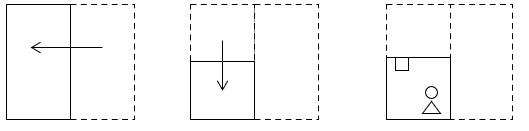
A paper is folded and cut as shown below. How will it appear when unfolded?
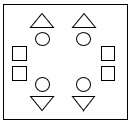
- (a)
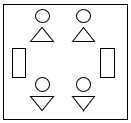
- (b)
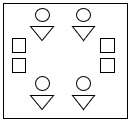
- (c)
- (d)
Answer
Why
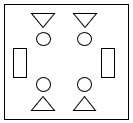
Correct — D.
Rule: unfold in reverse order, reflecting every cut across the fold line you open.
Folded right-onto-left, then top-onto-bottom, so the cut piece is the bottom-left quarter and every cut reappears four times.
In that quarter the circle sits above an upright triangle. Opening the horizontal fold reverses the order in the top half — triangle above circle, triangle inverted.
The small square sits on the fold line, so it merges with its reflection into one tall rectangle — and the vertical unfold gives a second, so one sits near each side edge.
Option (d) shows exactly that.
Why the others are wrong
- (a)Its bottom half shows the triangle pointing down, but the bottom half is the quarter you were given and its triangle points up. Its side cuts also stay two separate squares.
- (b)The side rectangles are right, but the circle sits above the triangle in both halves. Reflecting across the horizontal fold has to reverse that order in the top half.
- (c)Two faults. The bottom triangle points down when the cut quarter shows it pointing up, and the square cut is drawn as two separate squares rather than the single rectangle its position on the fold line forces.
Concept
Paper-folding items are solved backwards. Take the last fold first, reflect every cut across that fold line, then repeat for the fold before it.
Two folds mean each cut reappears four times, and the opened sheet is symmetric about both centre lines.
The detail that decides most of these is whether a cut touches a fold line. A cut away from the line gives two separate holes; a cut sitting on the line merges with its own reflection into one shape of double the size.
Orientation is the half of the answer that is easiest to drop. Reflection across a horizontal fold turns an upward triangle into a downward one — it does not slide the shape up unchanged.
Key facts
- Each fold doubles the number of holes, so two folds turn one cut into four.
- A cut touching the fold line merges with its reflection into a single shape of double size.
- Reflection across a horizontal fold reverses top-to-bottom order and inverts each shape.
- The opened sheet is symmetric about every fold line that was used.
Study next
Common traps
- Copying the cuts into all four quarters without inverting them
- Drawing two separate holes where the cut sat on the fold line
- Unfolding in the order the folds were made instead of in reverse
The stem is a fixed sentence and the whole question lives in the pictures. The same stem, word for word with different fold-and-cut figures, is asked on 11 Sep 2024, 09:00, Reasoning Q.15 and again at Reasoning Q.18 of that shift.
Related PYQs
No directly related past PYQ was found.