
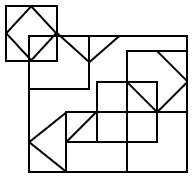
How many squares are there in the given figure?
- (a)12
- (b)13
- (c)15
- (d)14
Answer
Why
Correct — D. Count by size class, and count every closed shape that has four equal sides, not only the obvious cells.
Three squares share the figure's top-left corner: the small one, the medium one and the outer boundary of the whole figure — 3.
The square that overhangs at the top left, drawn partly outside that boundary, plus the tilted square inscribed in it with its corners on the four midpoints — 2.
In the block at the lower right, five squares of the single-cell size and four squares of double that size — 9.
3 + 2 + 9 = 14, option (d).
Why the others are wrong
- (a)12 — Twelve is two short. The tilted square inside the overhanging square counts as a square, and so does the outer boundary of the figure itself.
- (b)13 — Thirteen misses one shape. The outer boundary is a square in its own right and has to be counted, not only the squares drawn inside it.
- (c)15 — Fifteen over-counts. Only shapes with four equal sides qualify, so the two-cells-wide, one-cell-deep rectangles in the lower block must be left out.
Concept
Figure-counting rewards a system, not a sweep of the eye. Fix a size, count every square of that size, move up to the next size, then hunt separately for squares that are tilted or that straddle two regions.
Three things are easy to miss here: the outer boundary, which is a square containing everything else; the overhanging square at the top left, part of which lies outside that boundary; and the square inscribed at the midpoints, which reads as four triangles until you go looking for it.
The figure is drawn freehand and slightly out of proportion — measured on the printed image the outer boundary is a little wider than it is tall. Count the shapes the setter drew as squares rather than measuring them; that reading gives 14 and matches the Commission's key.
Key facts
- A square inscribed corner-to-midpoint inside another square is still a square and still counts.
- The outer boundary of a compound figure counts as one of its squares.
- Two cells side by side make a rectangle, not a square, however square the pair looks.
- Counting by size class, smallest first, is what stops a shape being counted twice.
Study next
Common traps
- Missing the outer boundary because it frames the picture instead of sitting inside it
- Reading the tilted square as four triangles and moving on
- Counting two-by-one rectangles as squares once the eye is tired
SSC gives one compound figure and four close numbers, so the marks turn on method rather than speed.
The same stem, word for word with a different figure, is asked on 10 Sep 2024, 16:00, Reasoning Q.13, keyed 13, and on 12 Sep 2024, 12:30, Reasoning Q.10, keyed 9 — the count has to be redone from the picture every time.
The triangle-counting variant is asked on 10 Sep 2024, 12:30, Reasoning Q.22.
Related PYQs
No directly related past PYQ was found.