
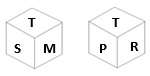
Six letters S, T, M, P, R and C are written on different faces of a dice. Two positions of this dice are shown in the figures below. Find the letter on the face opposite to M.
- (a)C
- (b)R
- (c)S
- (d)P
Answer
Why
Correct — B.
Rule: T is on top in both views, so the cube has only been spun about the vertical axis and the four side letters stay in one ring around T.
A quarter-turn one way would carry S round to the right-hand face; a quarter-turn the other way would carry M round to the left-hand face. The second view shows neither S nor M, so the cube has been turned a half-turn, 180 degrees.
A half-turn replaces every side face with the face opposite it. The right-hand face read M and now reads R, so M is opposite R — option (b).
Why the others are wrong
- (a)C — C is drawn in neither view, which makes it the hidden face opposite the top letter T. It is the one letter the two views never place beside M.
- (c)S — S and M are drawn on adjacent faces of the first view, meeting along the front vertical edge. Faces that share an edge can never be opposite.
- (d)P — The half-turn brings P to the left-hand face, where S had been, so P is opposite S. The letter arriving where M stood is R, not P.
Concept
Two views pin down opposite faces only when you can say how the cube moved between them.
Because T sits on top in both drawings, the movement is a rotation about the vertical axis, and the four side letters S, M, P and R stay in a single ring around T.
A quarter-turn always leaves one of the two visible side faces still visible. Neither S nor M reappears in the second view, so the turn has to be a half-turn, and a half-turn swaps each side face for its opposite.
That gives M opposite R and S opposite P. T, which appears in both views, is left with the only letter never drawn: C.
The two adjacency facts alone are not enough. They rule out S opposite M and P opposite R, but they leave two possible pairings — the amount of turn is what chooses between them.
Key facts
- The six letters are S, T, M, P, R and C, and C appears in neither view.
- Faces drawn together in one view share an edge, so S is not opposite M and P is not opposite R.
- A 180-degree turn about the vertical axis leaves the top face unchanged and replaces every side face with its opposite.
Study next
Common traps
- Assuming C must be opposite M just because C is never shown.
- Guessing between the two surviving pairings instead of settling how far the cube turned.
Six letters, two drawn views, one opposite face asked. Also asked 9 Sep 2024, 09:00, Reasoning Q.3 (Q, Z, V, T, L, A) and 10 Sep 2024, 12:30, Reasoning Q.19 (U, V, W, X, Y, Z).
Related PYQs
No directly related past PYQ was found.