
In which of the minor rock edicts of Emperor Ashoka, found in Madhya Pradesh, is his personal name mentioned?
- (a)Rupnath
- (b)Gurjara
- (c)Saro-Maro
- (d)Panguraria
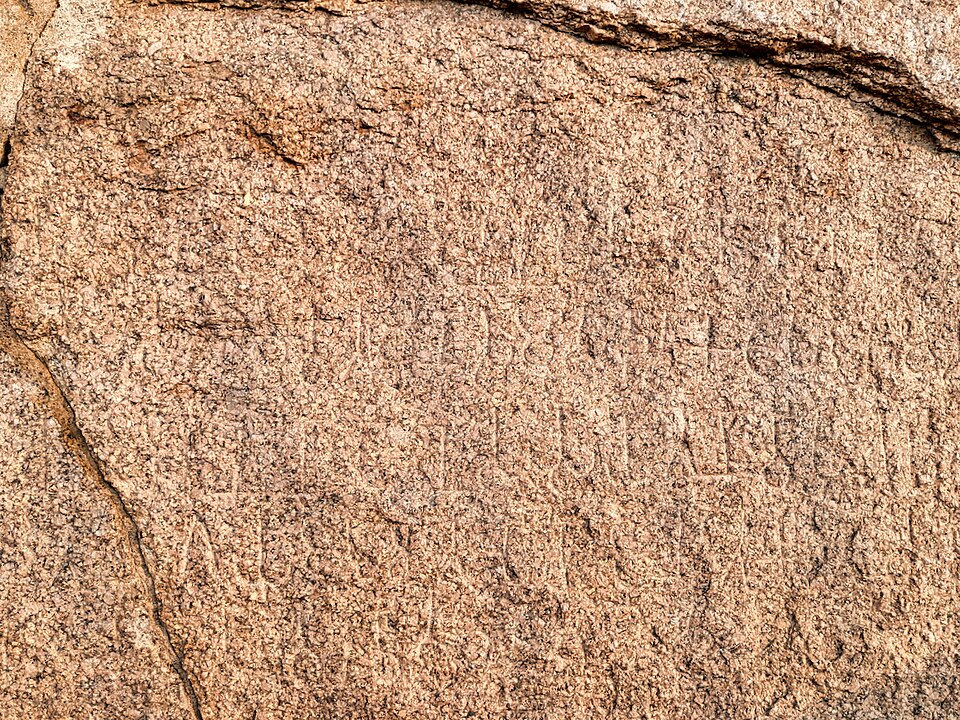
Correct — B, Gurjara (Gujarra), in Datia district of Madhya Pradesh. Almost every Ashokan edict hides the king behind titles — Devanampiya ('Beloved of the Gods') and Piyadasi ('of pleasing appearance') — and never gives his name. The Gujarra version of Minor Rock Edict I is one of the rare exceptions: its opening formula spells the name out, Devanampiyasa Piyadasino Asokaraja, so the personal name Ashoka stands next to the titles. It is the only Ashokan record in Madhya Pradesh that names him; the other edict sites where the name occurs — Maski, Nittur and Udegolam — all lie in Karnataka.
- (a)Rupnath — Rupnath, at the foot of the Kaimur hills in Katni district, is genuinely one of Madhya Pradesh's Ashokan sites and carries Minor Rock Edict I — but its text uses only the royal styles Devanampiya/Piyadasi. Being a famous MP edict is not the same as naming the king.
- (c)Saro-Maro — The Saru-Maru rock-shelter inscriptions in Sehore district are Ashokan and important — one of them is read as recording a visit the king made to the spot while he was still a prince — but they identify him by title, not by personal name. Note also that Saru-Maru and Panguraria in option (d) are the same rock-shelter complex, which is a strong hint that neither can be the single intended answer.
- (d)Panguraria — Panguraria is the village in Sehore district beside those same Saru-Maru shelters, which is why the record there is cited as the Panguraria/Saru-Maru inscription. It, too, uses the titles Devanampiya and Piyadasi rather than the name Ashoka.
Ashoka's inscriptions form the earliest large body of deciphered Indian writing: 14 Major Rock Edicts, a set of Minor Rock Edicts, 7 Pillar Edicts, Minor Pillar Edicts and cave dedications (Barabar). They are mostly in Prakrit written in Brahmi, with Kharoshthi in the north-west and Greek and Aramaic versions at Kandahar. In almost all of them the emperor calls himself only Devanampiya Piyadasi. James Prinsep deciphered Brahmi in 1837, but tying 'Devanampiya Piyadasi' to Ashoka rested on the Sri Lankan chronicles until the Maski edict (found 1915) supplied the personal name directly; Gujarra, found in the 1950s, confirmed it — and is the Madhya Pradesh example of that rare naming.
The setter has stacked the option list with all three of MP's Ashokan Minor Rock Edict localities, and then split one of them into two names (Saro-Maro and Panguraria) so that a candidate who only remembers 'there is an Ashokan edict in Sehore' has two ways to go wrong. The way through is not to recall the districts but to recall the single distinguishing fact: name-bearing edicts = Maski, Gujarra, Nittur, Udegolam. Only Gujarra of that set is in Madhya Pradesh.
- Gujarra (Gurjara), Datia district, MP — Minor Rock Edict I reading 'Devanampiyasa Piyadasino Asokaraja'
- Edicts that carry the personal name Ashoka: Maski, Gujarra, Nittur and Udegolam — all Minor Rock Edicts
- MP's Ashokan Minor Rock Edict localities: Rupnath (Katni), Gujarra (Datia), Panguraria / Saru-Maru (Sehore)
- Standard styles used in the edicts: Devanampiya ('Beloved of the Gods') and Piyadasi
- James Prinsep deciphered Brahmi in 1837; the Maski edict (1915) first attached the name Ashoka to those titles
- Assuming every Ashokan edict names him — the overwhelming majority say only Devanampiya Piyadasi
- Treating Saro-Maro and Panguraria as two separate sites; they are one Sehore-district complex
- Mixing up Rupnath (Katni, MP) with Maski (Raichur, Karnataka) — the famous MP edict is not the name-bearing one
MPPSC keeps it local — which inscription lies in which MP district and what is peculiar about it. UPSC asks the same corpus from three angles: which edict names Ashoka (1997), who first deciphered the edicts (2016), and site-to-state matching of the major rock edicts (2022).
Which one of the following edicts mentions the personal name of Asoka?
- (a) Kalsi
- (b) Rummindei
- (c) Special Kalinga Edict
- (d) Maski
Answer(d) Maski
The identical concept — which edict drops the titles and gives the name 'Asoka'. UPSC picked the Karnataka example (Maski); MPPSC 2026 picked the Madhya Pradesh one (Gujarra).
In which of the following relief sculpture inscriptions is 'Ranyo Ashoka' (King Ashoka) mentioned along with the stone portrait of Ashoka?
- (a) Kanganahalli
- (b) Sanchi
- (c) Shahbazgarhi
- (d) Sohgaura
Answer(a) Kanganahalli
Same underlying point from the art-history side — the handful of records that name Ashoka outright, here a relief labelled 'Ranyo Asoko' rather than an edict.
- practice — not a real PYQ
Which pair of Ashokan Minor Rock Edict sites lies in Madhya Pradesh?
- (a)Maski and Brahmagiri
- (b)Rupnath and Gujarra
- (c)Sasaram and Bairat
- (d)Nittur and Udegolam
Answer(b) Rupnath and Gujarra — Rupnath is in Katni district and Gujarra in Datia district; Maski, Brahmagiri, Nittur and Udegolam are in Karnataka, Sasaram is in Bihar and Bairat in Rajasthan. - practice — not a real PYQ
In his inscriptions, Emperor Ashoka most commonly refers to himself by which titles?
- (a)Devanampiya and Piyadasi
- (b)Chakravartin and Samrat
- (c)Maharajadhiraja and Parameshvara
- (d)Devaputra and Shahanushahi
Answer(a) Devanampiya and Piyadasi — 'Beloved of the Gods' and 'of pleasing appearance'; Devaputra/Shahanushahi are Kushana titles and Maharajadhiraja/Parameshvara are later Gupta-era usages.